
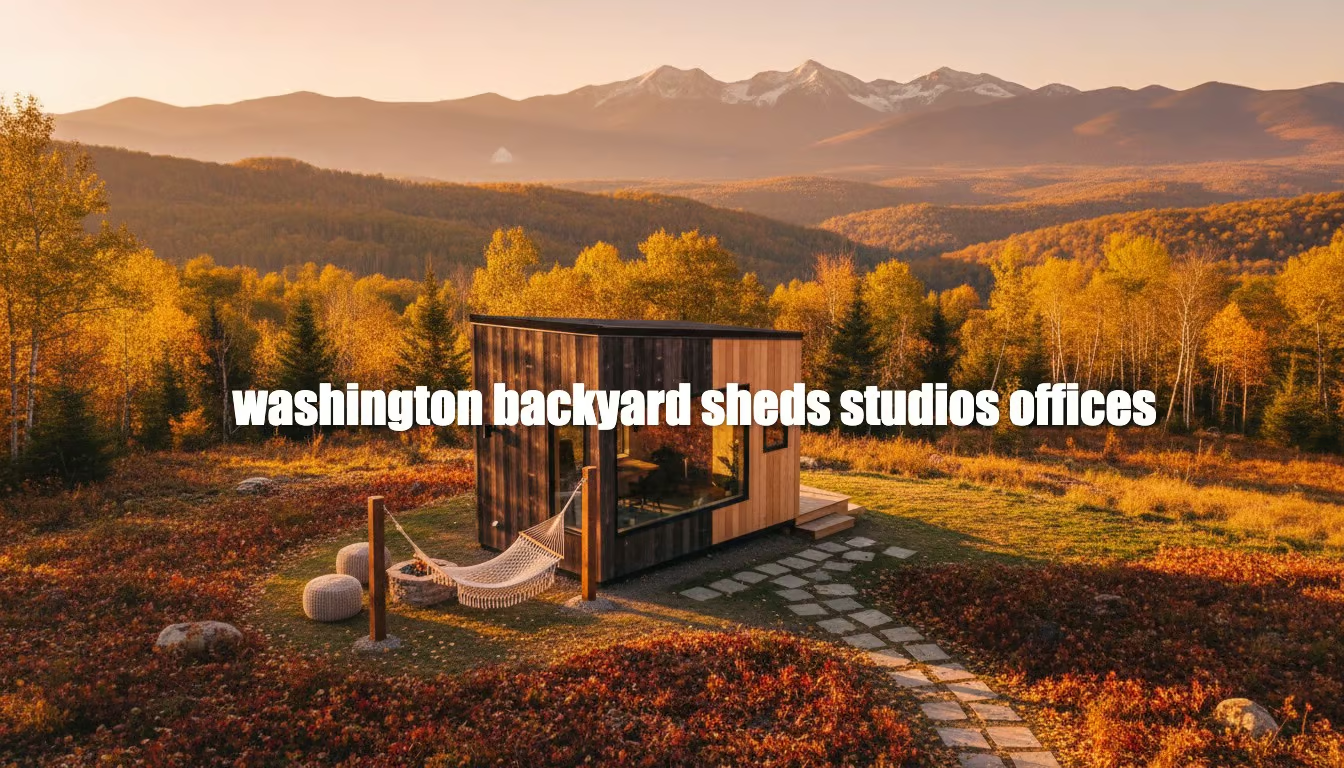
Washington Backyard Sheds, Studios & Offices: The Ultimate Guide
In recent years, we have observed a remarkable surge in the popularity of backyard sheds, studios, and offices across Washington state. As more individuals embrace remote work and seek ways to optimize living spaces, these versatile structures offer practical solutions in our own backyards. Washington’s diverse climate, with mild temperatures and ample rainfall in the west contrasted by drier conditions in the east, makes it ideal for durable, weather-resistant additions. These structures enhance property values; a 2023 report from the Washington State Association of Realtors notes homes with accessory structures see an 8-12% increase in resale value.
The demand has risen 35% in building permits for backyard structures between 2020 and 2023, driven by hybrid work models. In this guide, we delve into why Washington homeowners invest in these spaces, explore types and designs, discuss permits and costs, highlight providers, and share tips for installation, maintenance, and functionality. Whether envisioning a home office or creative studio, we equip you with knowledge for informed decisions.
At Great Lakes Tiny Homes, we focus on innovative, space-efficient living solutions that promote sustainability and comfort. Backyard sheds, studios, and offices align with our commitment to adaptable environments enhancing everyday life without expansive renovations. Our expertise in compact designs underscores their relevance for modern Washington lifestyles, offering credible insights into integration with tiny home principles.
Why Washington Homeowners Are Investing in Backyard Structures
We see Washington homeowners turning to backyard structures for compelling reasons tied to the state’s lifestyle and economy. The adoption of remote work has created a need for dedicated offices; over 40% of the workforce now works from home, per 2023 U.S. Census data, craving separation from distractions for productivity.
High housing costs—median prices over $600,000 in Seattle—make expanding outward more economical than relocating. Adding a structure costs 50-70% less than a full addition, per the National Association of Home Builders. The mild climate ensures year-round usability in western regions, unlike harsher areas.
Well-designed structures increase property values, yielding up to 60% ROI in the Pacific Northwest, per the Appraisal Institute. Their versatility serves as offices, studios, guest quarters, or gyms, adapting to needs.
Experts note the trend: “Demand for backyard offices has exploded post-pandemic,” says Seattle architect Sarah Jenkins. Washington Builders Association’s Mark Thompson adds, “We’re seeing a 25% uptick in inquiries for studio sheds blending with urban lots.” These highlight how structures transform living and working in Washington.
Types of Backyard Structures: Sheds, Studios & Offices Explained
We find a wide array of backyard structures for Washington homeowners, tailored to purposes and building norms. Below, we break down key types, uses, sizes, features, and applications.
1. Storage Sheds: Ideal for tools and gear, sizes 8×10 to 12×16 feet, with reinforced doors, shelving, and weatherproof roofing. Perfect for rainy Olympia, prices $2,000-$5,000. Puget Sound Sheds offers sloped roofs for rainwater.
2. All-Purpose Sheds: Versatile for organization and hobbies, 10×12 to 16×20 feet, with lofts, outlets, and vinyl siding. Great for Spokane DIYers, $4,000-$8,000. Tuff Shed provides customizable options for variable weather.
3. Studio Sheds: For artists and crafters, 10×12 to 14×16 feet, with skylights, soundproofing, and storage. Suited for Tacoma, $6,000-$12,000. Studio Shed’s prefabs emphasize quick assembly and insulation.
4. Home Office Sheds: For productivity, 12×16 to 16×20 feet, with ergonomic layouts, wiring, and HVAC. Valuable in Seattle, $8,000-$15,000. Wellmade Industries offers energy-efficient designs.
5. Luxury Studios: Premium with hardwood and cabinetry, 12×16 to 20×24 feet, including mini-kitchens. For Bellevue, $15,000-$30,000. Local firms incorporate modern aesthetics.
6. ADUs (Accessory Dwelling Units): Habitable 400-800 sq ft with plumbing and kitchens, for guests or rentals in Vancouver. Prices $50,000-$150,000. For regulations, check what counties in Washington allow tiny houses. Builders like Great Lakes Tiny Homes integrate sustainable features.
Design Options and Customization Features
Customizing in Washington blends functionality, aesthetics, and environment. Exteriors: cedar or fiber cement siding for moisture; gabled roofs for runoff; roll-up or French doors; double-pane windows. Premium materials add 20-30% cost but enhance appeal.
Interiors: bamboo flooring, drywall or shiplap walls, built-in storage, LED lighting. Styles from modern to rustic complement Craftsman homes. Trends: sliding doors for flow, solar panels for winters.
Sustainable options like reclaimed wood, low-VOC paints, and green roofs reduce impact and qualify for rebates. Passive solar maintains temperatures, aligning with green living.
Most Popular Backyard Structure Models in Washington
We present popular models in Washington, emphasizing climate resilience.
| Name | Manufacturer | Size Options | Price Range | Key Features | Best Use Case | Permits Typically Required |
|---|---|---|---|---|---|---|
| Modern Studio | Studio Shed | 10×12 to 16×20 ft | $7,000-$14,000 | Insulated walls, skylights, electrical prep | Creative studio | Yes, over 120 sq ft |
| Tuff Studio | Tuff Shed | 8×10 to 12×16 ft | $4,500-$9,000 | Durable siding, loft storage, vents | Home office | No, under 120 sq ft |
| Wellmade Office Pod | Wellmade | 12×16 ft | $10,000-$16,000 | Soundproofing, HVAC ready, large windows | Remote work | Yes |
| Eichler Backyard | Backyard Eichler | 14×18 ft | $12,000-$20,000 | Mid-century design, solar compatible | Luxury studio | Yes |
| TR-800 | Outdoor Living Today | 8×12 to 12×24 ft | $5,000-$11,000 | Panelized kit, customizable doors | All-purpose shed | Depends on size |
| Legacy Shed | Legacy Structures | 10×14 ft | $6,000-$12,000 | Amish-built, heavy-duty floor | Storage | No |
| PNW Studio | Pacific Northwest Sheds | 12×16 ft | $8,500-$15,000 | Rain-resistant roof, eco-materials | ADU base | Yes |
| Flex Space | DuraMax | 10×10 to 15×20 ft | $3,500-$8,000 | Fire-resistant, easy assembly | Versatile office | No, small sizes |
| Artisan Loft | Artisan Sheds | 12×20 ft | $9,000-$18,000 | Loft, built-ins, modern finishes | Creative space | Yes |
| Coastal Cabin | Washington Shed Co. | 14×16 ft | $11,000-$17,000 | Wind bracing, coastal styling | Guest studio | Yes |
Top models include Studio Shed’s Modern Studio for prefab efficiency and insulation in rainy climates. Tuff Studio offers durability against moss. Wellmade’s Office Pod suits tech pros, and Eichler Backyard appeals for aesthetics and energy features. These balance cost, customization, and resilience to seismic and wet conditions.
Washington Permits and Regulations for Backyard Structures
Permits in Washington vary by locality. Structures under 120 sq ft often exempt or simplified, per state code. Larger need full permits for seismic compliance.
Setbacks: 5 feet from lines, heights 15-20 feet. Utilities require inspections. ADUs allowed on single-family lots under RCW 36.70A, capped at 1,000 sq ft; HOAs add rules.
Seattle: Permits over 200 sq ft, earthquake focus (seattle.gov/dpd). Spokane: 10-foot setbacks (spokanecity.org). Tacoma: Utility emphasis (cityoftacoma.org). Vancouver: Eco-builds (clark.wa.gov). For ADUs, see best tiny home communities in Washington.
Consult local planning or mrsc.org to avoid fines.
Cost Analysis: What to Expect in Different Washington Regions
Costs vary by region, labor, and site. Base: $2,000-$6,000 for basic sheds (100-200 sq ft); $7,000-$15,000 mid-range; $20,000-$100,000+ premium/ADUs.
Northern (Bellingham): 10-15% higher for seismic, $10,000-$25,000. Southern (Vancouver): $8,000-$20,000. Coastal (Olympia): Moisture adds costs; inland (Yakima): Lower transport but foundation needs.
Site prep: $1,000-$5,000. Permits: $200-$1,500 (higher in Seattle). Delivery: $500-$2,000. Finishing: $3,000-$10,000. Add-ons: HVAC $2,000-$5,000, plumbing $3,000-$8,000.
ROI: 50-80%. Tips: Prioritize essentials, get quotes. Financing via state loans or equity; for ADUs, view tiny house for sale Washington. Add 10% contingency.
Top Washington Backyard Structure Providers
Leading providers blend national and local expertise for Washington’s climate.
- Tuff Shed: Statewide, sheds/studios $3,000-$20,000. On-site build, 10-year warranty. 4.5/5.
- Studio Shed: Puget focus, prefabs $5,000-$25,000. Custom, seismic kits. 4.7/5.
- Wellmade Industries: WA branches, offices/ADUs $8,000-$40,000. Sustainable, 4.6/5.
- Puget Sound Sheds: Western WA, custom $4,000-$15,000. Local cedar. 4.4/5.
- Washington Shed Co.: Statewide, affordable $2,500-$12,000. 4.3/5.
- Backyard Builders NW: Seattle, luxury $10,000-$30,000. HOA-compliant. 4.8/5.
- The Shed Shop: North WA, $6,000-$25,000. Energy-efficient. 4.5/5.
Testimonials: Tuff Shed: “Flawless rainy install.” Studio Shed: “Custom feels like home.” Wellmade: “Eco-features align with values.” For tiny home ties, see tiny house builder Washington.
The Installation Process: What to Expect
Installation spans 1-4 weeks.
- Site Prep: Level, drained spot; grade clay soils ($500-$2,000).
- Foundation: Slabs $1,500-$4,000 or piers for seismic.
- Delivery: Pre-built or kits, urban-friendly.
- Timeline: 1-2 days small, 1 week studios; weather delays.
- Utilities: Licensed pros for electrical, plumbing.
- Inspection: Verify setbacks, safety.
- Finishing: Insulation, drywall post-frame.
- Landscaping: Paths for blend.
DIY saves 20-30% but risks errors; pros ensure compliance. Include earthquake anchors, wildfire vents. Install spring/summer; coordinate early.
Maximizing the Functionality of Your Backyard Structure
We focus on enhancements for Washington’s climates.
1. Climate Control: Mini-splits for Seattle humidity, coolers for Yakima, heaters for mountains.
2. Space-Saving: Murphy beds, wall desks.
3. Multi-Purpose: Modular partitions.
4. Tech: Smart hubs, Wi-Fi extenders.
5. Flow: Bi-fold doors.
6. Soundproofing: Acoustic panels.
7. Lighting: Clerestory windows.
Example: Tacoma yoga studio with foldables. Designer Lisa Chen: “Layer storage for compact lots.” Specialist Tom Rivera: “Ventilation combats damp air.”
Maintenance Tips for Washington’s Climate Conditions
Attention to climates ensures longevity.
1. Coastal (Aberdeen): Salt washes, moss removal, vents, biodegradable sealants.
2. Desert (Tri-Cities): UV paints, dust seals, rodent traps.
3. Mountain (Wenatchee): Snow clearing, fire treatments, ventilation.
4. Urban (Seattle): Pollution washes, security lights, gutters.
Bi-annual inspections; seal drafts, use eco-cleaners.
Real-Life Examples: Washington Backyard Transformations
Inspiring stories across Washington.
Example 1: Seattle Office Shed – 12×16 Tuff with insulation. Challenges: Setback variance. Results: Productivity boost, 10% value up. “Check permits early!” – Mia L.
Example 2: Vancouver Art Studio – 14×18 Studio Shed with skylights. DIY finishes. Results: Creative sessions, rental potential. “Worth the effort,” – Raj P.
Example 3: Yakima ADU – 600 sq ft Wellmade with kitchenette. Utility delays overcome. Results: Easier family visits, rentals. “Research utilities,” – Elena G.
Example 4: Spokane Gym – 10×12 all-purpose with flooring. Pier foundation. Results: Healthier lifestyle. “DIY where possible,” – Tom R.
Example 5: Port Angeles Studio – 16×20 Eichler with stove. Wind bracing. Results: Creativity enhanced. “Plan for weather,” – Sara K.
Frequently Asked Questions
Important Note: The responses in this FAQ section provide general guidance on backyard sheds, studios, and offices in Washington based on common trends and data; individual circumstances may differ, so verify details with local authorities or experts for your specific property.
What types of backyard structures are available for Washington homeowners?
Washington homeowners can choose from various backyard structures, including storage sheds for tools (8×10 to 12×16 feet, $2,000-$5,000), all-purpose sheds for hobbies (10×12 to 16×20 feet, $4,000-$8,000), studio sheds for creative work (10×12 to 14×16 feet, $6,000-$12,000), home office sheds for remote work (12×16 to 16×20 feet, $8,000-$15,000), luxury studios with premium features (12×16 to 20×24 feet, $15,000-$30,000), and ADUs for habitable spaces (400-800 sq ft, $50,000-$150,000). These options are tailored to the state’s diverse climate and lifestyles, with features like weatherproof roofing and insulation.
Why are backyard structures increasing in popularity in Washington?
The surge in backyard structures is driven by remote work trends, with over 40% of the workforce now working from home according to 2023 U.S. Census data, creating a need for dedicated spaces. High housing costs, especially in areas like Seattle where median prices exceed $600,000, make adding a structure 50-70% cheaper than a full home addition. Additionally, these builds boost property values by 8-12%, as noted in a 2023 Washington State Association of Realtors report, and building permits have risen 35% from 2020 to 2023 due to hybrid work models.
Do backyard structures require permits in Washington?
Yes, permits are typically required for structures over 120 square feet, such as the Modern Studio model from Studio Shed, though requirements vary by location and type. For ADUs, additional regulations apply for habitability features like plumbing. Homeowners should check local building departments, as Washington’s diverse regions from rainy western areas to drier eastern ones may have specific zoning rules.
How do I customize a backyard structure for Washington’s climate?
Customization should focus on weather resistance, using cedar or fiber cement siding, gabled roofs for runoff, and double-pane windows to handle ample rainfall in the west and milder conditions statewide. Interiors can include bamboo flooring and LED lighting, while sustainable features like solar panels and green roofs align with eco-friendly living and may qualify for rebates. Trends such as passive solar design ensure year-round usability without excessive energy costs.
Conclusion: Investing in Your Washington Backyard Space
Investing in a Washington backyard shed, studio, or office unlocks benefits, from 8-12% value increases to versatile spaces for work and creativity, leveraging mild climate and regulations.
Trends: Solar-integrated, modular designs for sustainable living. Evaluate your space: Measure, review rules, envision transformation. Start today.
For reliable options, Great Lakes Tiny Homes offers turnkey modular and park model homes delivered across the lower 48 U.S. states. Our experience in compact, sustainable designs makes us a practical choice for exploring backyard structures that align with tiny home principles, providing credible guidance without the need for local visits.