
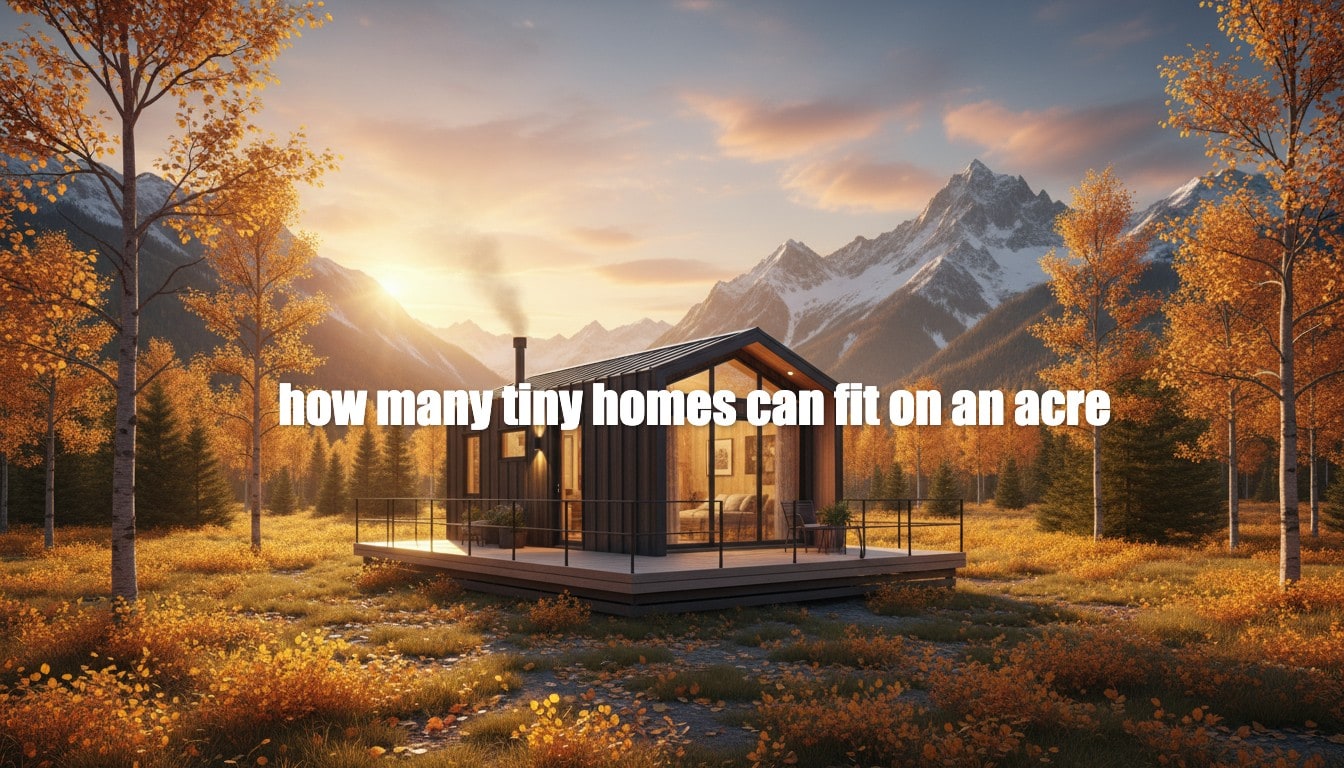
We often get asked how many tiny homes can fit on an acre, and the answer isn’t straightforward. Typically, we find that 10 to 18 tiny homes can fit on one acre, depending on zoning laws, layout designs, and home sizes. This range highlights practical land use realities in the tiny house movement. An acre provides about 43,560 square feet, roughly a football field without end zones, but not all is usable for building.
This question impacts us as enthusiasts, developers, and owners, affecting cost efficiency, community planning, and investment. Maximizing units lowers per-unit land costs for affordable housing, but excessive density risks regulations or reduced quality of life. In this guide, we cover key influences: zoning minimums, setbacks, utilities, and parking.
The tiny home movement grows with our desire for sustainable, minimalist living amid rising costs. Acre calculations aid intentional communities or investments. Local variations surprise us—some areas allow 18 units, others cap at 10. We explore measurements, regulations, layouts, and economics for your planning.
At Great Lakes Tiny Homes, we view density planning as essential for families and investors shifting to smaller spaces. Our modular designs and community experience highlight its role in viable tiny homes across the US, drawing from municipal codes and case studies for reliable insights.
Understanding Acre Dimensions and Usable Space
To determine tiny home fits, we start with basics: an acre is 43,560 square feet, a square plot of 208.7 by 208.7 feet, like 16 tennis courts.
Not all space is usable; we differentiate gross from net acreage, subtracting 20-30% for roads, utilities, drainage, setbacks, and common areas. Roads take 10-15% (4,356-6,534 sq ft), setbacks 5-10%, drainage/utilities 5%.
Buildable space shrinks to 30,492-34,848 sq ft (70-80%). This affects counts; ignoring it overestimates by 20-30 units.
| Category | Percentage of Acre | Square Feet (on 1 Acre) |
|---|---|---|
| Gross Acreage | 100% | 43,560 |
| Roads & Pathways | 10-15% | 4,356-6,534 |
| Setbacks & Easements | 5-10% | 2,178-4,356 |
| Utilities & Drainage | 5% | 2,178 |
| Common Areas | 0-5% | 0-2,178 |
| Net Usable Space | 70-80% | 30,492-34,848 |
This shows deductions leaving less for homes. We advise starting calculations here to avoid unfeasible plans.
Standard Tiny Home Sizes and Their Space Requirements
Tiny home sizes vary, dictating density. Categories: micro (<150 sq ft), small (150-250), standard (250-400), large (400-600). Footprint is part; include setbacks and outdoor areas.
A micro home (100 sq ft footprint) needs 500 sq ft lot with 5-ft setbacks. THOWs (8-10 ft wide, 20-40 ft long) follow RV rules; foundation models stricter codes. Examples: Tumbleweed Cypress (400 sq ft, 8.5×26.5 ft), Escape Traveler (under 400 sq ft).
Theoretically, over 100 micros fit without deductions, but realistically fewer. Comparison:
| Category | Footprint (sq ft) | Recommended Lot Size (sq ft) | Max Units per Acre (usable space) |
|---|---|---|---|
| Micro | <150 | 400-600 | 50-80 |
| Small | 150-250 | 600-1,000 | 30-50 |
| Standard | 250-400 | 1,000-2,000 | 15-30 |
| Large | 400-600 | 2,000-3,000 | 10-15 |
A standard on 1,500 sq ft lots fits about 20 units. Smaller homes enable higher density.
How Zoning Laws and Regulations Affect Tiny Home Density
Zoning controls density: R-1 requires 5,000-10,000 sq ft/unit (4-8/acre); R-3 2,000-5,000 (8-20). Density caps like 12/acre limit further.
Setbacks (front 15-25 ft, side 5-10, rear 10-20) consume 10-20%. Tiny homes as primary, ADUs, or RVs have rules; ADUs add one without density impact. Variances possible in friendly states like California, Oregon, Texas, Florida.
In Austin, TX (R-3), 1,800 sq ft lots allow 20/acre with variances—see Best Tiny Home Communities in Texas. Portland, OR eco-villages permit 15. Miami-Dade, FL RV parks 12/acre. Spokane, WA rural 4,000 sq ft lots—check What Counties in Washington Allow Tiny Houses.
Research: 1) City/county planning site; 2) Zoning maps/ordinances; 3) Building dept for tiny specifics; 4) State codes via IRC Appendix Q.
Calculating Setbacks and Spacing Requirements
Setbacks buffer for safety/privacy: front 15-25 ft, side 5-10, rear 10-20. Spacing 10-20 ft between structures.
For 208.7×208.7 ft: Subtract front (20 ft): 188.7 ft; rear (15 ft): 173.7 ft; sides (7.5 each): 193.7 ft. Buildable ≈33,660 sq ft. Then spacing.
Formula: (Length – Front – Rear) x (Width – Sides) – (Spacing x Units). Corner lots vary; easements add 5-10 ft.
Example: 33,660 sq ft for 300 sq ft homes on 1,500 sq ft lots ≈22 units, but zoning lowers. Use spreadsheets for custom.
Optimal Layout Configurations for Maximum Density
Layouts boost counts 20-30%: grid (efficient, rigid), cluster (community, flexible), courtyard (balanced green), linear (access), circular (aesthetic).
Grid maximizes; cluster shares walls. Shared amenities reduce needs. Parking (1-2/unit, 300-400 sq ft) takes 20%; roads 20 ft wide.
Tips: Solar orientation, permeable paths. Grid: 12 units (10×20 homes, 15 ft spacing, 30% paths/parking). Cluster: 15 by pods. Courtyard: 14 around 5,000 sq ft green. Layouts show power in fitting more.
Infrastructure and Utility Considerations
Infrastructure limits: Water/sewer $5,000-10,000/unit; shared cuts 30%. Electrical $2,000-5,000/unit. Shared septic saves 10% space.
Roads 20-24 ft (15% area); drainage 5-10%. Off-grid (solar, composting) boosts 10-20%; rainwater frees sewer.
Costs: Hookups $15,000-25,000/unit (down with density); off-grid $10,000-15,000. Hookup: 12 units (2,000 sq ft utilities); off-grid: 16. Density amortizes costs.
Parking Space Requirements and Their Impact on Density
Parking: 9×18 ft spot (162 sq ft) + aisles (300-400 total). 1-2/unit + guest. For 15 units (1.5 spaces): 22.5 x 350 =7,875 sq ft (20%).
Drops to 12 homes. Alternatives: Shared (1/space), compact, tandem, structures (save 50%). Perimeter placement frees center.
Calculation: Reduces buildable, fits 12. Off-site/bike options max density.
| Municipality Type | Spaces/Unit | Total SF for 10 Units |
|---|---|---|
| Urban | 1 | 3,500 |
| Suburban | 1.5 | 5,250 |
| Rural | 2 | 7,000 |
Planning varies by area, saves space.
Real-World Tiny Home Community Examples
US examples: 1) Detroit’s Tiny House Block: 1 acre, 12 units (200-300 sq ft), grid, 12/acre. ADUs, shared utilities. Urban revitalization.
2) Orlando, FL: 2 acres, 25 THOWs (150-400 sq ft), cluster, 12.5/acre. RV rules, off-grid solar. Mobile flexibility.
3) Delta, CO: 5 acres, 40 units (250 sq ft), courtyard, 8/acre. Eco-variance, amenities for families.
4) Tiny Texas Houses, TX: 3 acres, 45 units, linear, 15/acre. THOWs on ag land, off-grid.
5) Spokane, WA: 1.5 acres, 18 units (300 sq ft), cluster, 12/acre. Shared parking, rental. For more, Tiny House For Sale Spokane.
Densities 8-15/acre; high via variances/off-grid. Mix urban/rural shows possibilities.
Strategies for Maximizing Tiny Homes Per Acre
Prioritize: 1) Variances (+5-10 units, e.g., Portland +8). 2) Two-story (+20%, lofts 15 vs. 12). 3) Shared amenities (+3-5, Orlando laundry). 4) Efficient roads (+2). 5) THOWs (+5, Texas). 6) Cluster (+4-6, Colorado bonuses). 7) ADUs (+2-4).
Framework: Assess site, research codes, design vertical/shared, apply variances. 10-20% increases possible. Link: Tiny House Builder Seattle.
Cost Analysis: Economics of Tiny Home Density
Density economics: 10/acre land $5,000/unit; 15 $3,333. Infrastructure: $20,000 low, $12,000 medium (20-30% down high).
Break-even: Low (8 units) $400,000 cost, $2.56M revenue, 5 years 8% ROI. Medium (12): $480,000, $2.4M, 4 years. High (16): $512,000, $3.2M, 3 years. Rental: $192,000/year high vs. $96,000 low.
Density boosts values 10-15%; over hurts market. Financing favors dense sustainable.
| Density | Total Cost | Per-Unit Cost | ROI (5 yrs) |
|---|---|---|---|
| Low (8) | $400,000 | $50,000 | 8% |
| Medium (12) | $480,000 | $40,000 | 12% |
| High (16) | $512,000 | $32,000 | 16% |
Balancing Density with Quality of Life
Balance max density with privacy (10-15 ft buffers), noise control, outdoor space (200 sq ft/unit). High fosters community, risks stress; low enhances solitude.
Needs: 500 sq ft yards/shared gardens. Optimal 10-12/acre for satisfaction. Family 8-10; retiree 10-12; urban 12-15; rural 6-8. Amenities like trails help. Insights: Dense vibrant, spacious private. For Washington, Best Tiny Home Communities in Washington.
Common Mistakes to Avoid When Planning Tiny Home Density
Avoid: Skipping zoning (CA halt, $50,000 delay). Underestimating utilities (TX +20% space, 15 to 12 units). Ignoring setbacks (18 to 10). Sloped lots lose 30%. Drainage oversight (FL +15%). Max density turnover from noise. No expansion.
Checklist: 1) Zoning; 2) Survey; 3) Calc setbacks/parking; 4) Utilities; 5) Market; 6) Variances; 7) Input. Prevention key.
Frequently Asked Questions About Tiny Homes Per Acre
Can we put multiple tiny homes on our residential lot? Yes, if ADUs allowed—one primary + one in CA, up to 2-3. Check codes; HUD guide.
What’s the minimum lot size for one tiny home? 2,500-5,000 sq ft suburban; rural WA 4,000. Effective 3,000 with setbacks.
Do tiny homes on wheels have different density rules? Yes, RV parks 8-12/acre; TX THOWs 15 vs. 10 foundation. IRC Appendix Q.
How does tiny home density compare to traditional housing? 2-3x higher (10-18 vs. 4-6). Affordability via design.
What states are most friendly to tiny home communities? CA, OR, TX, CO, FL—OR clusters. WA emerging; What Counties in Washington Allow Tiny Houses.
Can we build a tiny home community on agricultural land? With rezoning; TX 10/acre THOW farms. Ag dept, reviews.
How do HOAs affect tiny home density? Restrict; seek friendly, amend. Review bylaws.
Are off-grid tiny homes easier for high density? Yes, +10-20%; solar/composting legal, permits vary.
How much do setbacks vary by state? CA 5-20 ft, TX 10-25. Local search.
Can vertical designs increase density? Yes, lofts -30% footprint; height 20-30 ft allowed.
Final Thoughts: Determining the Right Tiny Home Density for Your Acre
We fit 10-18 per acre, varying by zoning, goals. Balance regulations, returns, livability.
Framework: 1) Zoning research; 2) Usable space ( -20-30%); 3) Goals; 4) Layouts/utilities; 5) Variances; 6) Budget; 7) Amenities.
Prioritize viability: zoning, setbacks, parking, infrastructure. Action: Local regs, planners, communities like Tiny House For Sale California. Creative solutions for sustainable living.
Checklist: [ ] Zoning; [ ] Space; [ ] Density goal; [ ] Cost; [ ] Layout; [ ] Consult; [ ] Visit.
Great Lakes Tiny Homes offers credible experience in turnkey modular and park model homes delivered across the lower 48 states, making us a reliable partner for exploring tiny living options tailored to your needs.