
As Colorado’s population ages and housing costs continue to rise, more families are turning to granny pods as a practical way to keep loved ones close while preserving their independence. These compact, purpose-built dwelling units provide Colorado families with the means to offer support and companionship to elderly relatives without sacrificing privacy or autonomy. With the state’s growing emphasis on multigenerational living, granny pods have emerged as a viable solution amid increasing demand for affordable senior housing options.
In this comprehensive guide, we’ll cover everything Colorado families need to know about granny pods, from the latest legal considerations and zoning regulations to design features, installation processes, and cost breakdowns. Whether you’re located in urban centers like Denver and Colorado Springs or in more rural mountain areas, understanding how granny pods fit into Colorado’s diverse landscape is essential. We’ll also explore recent state legislation that streamlines ADU approvals, helping families navigate the evolving regulatory environment effectively.
At Great Lakes Tiny Homes, we specialize as a full-service manufacturer of modular, park model, and tiny homes, delivering turnkey builds to all 48 lower U.S. states. Our options include configurations with or without wheels and with or without RVIA certification, where models with RVIA certification are often referred to as Park Models. Drawing from our extensive experience in custom accessory dwelling units, we prioritize creating spaces that foster family connections while meeting stringent building standards. If you’re exploring granny pod possibilities, consider booking a call with our experts to discuss your specific needs: Book a call.
Granny pods, classified as accessory dwelling units (ADUs), are permitted in many Colorado counties and cities under local zoning ordinances, with a new state law (HB24-1152) effective June 30, 2025, mandating that most jurisdictions allow at least one ADU on lots with single-family detached homes. Regulations typically include minimum lot sizes of 5,000 to 7,000 square feet, maximum unit sizes of 800 to 1,000 square feet or 50% of the primary dwelling, and requirements for setbacks and owner occupancy in some areas. Families should consult local planning departments for jurisdiction-specific rules, as variations exist across urban and rural locales.
Disclaimer: This article is for informational purposes only and does not constitute legal advice. Laws, regulations, and zoning rules vary by location and may change over time. Always consult your local zoning office or a qualified land use/zoning attorney before making decisions based on this information.
What Are Granny Pods?
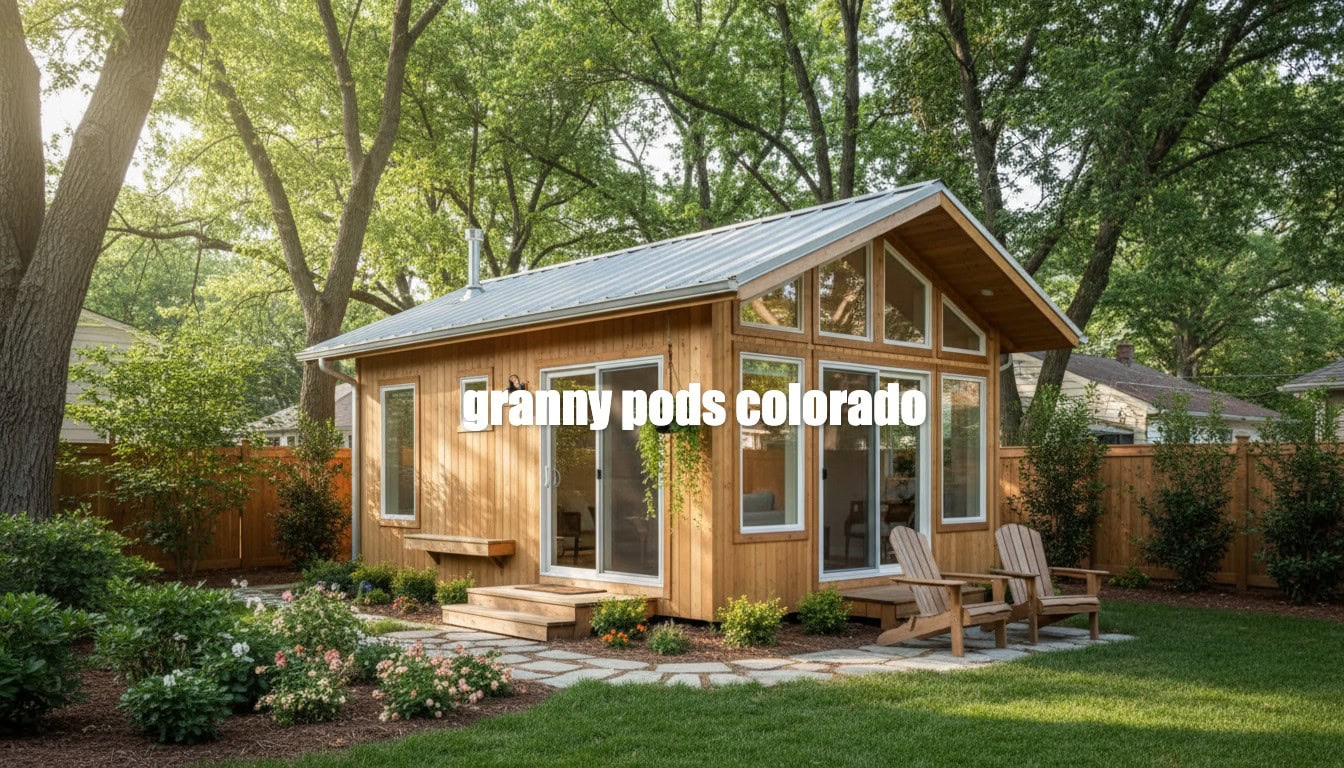
Granny pods are small, detached dwelling units designed specifically to accommodate aging relatives on the property of their family members. Also known as accessory dwelling units (ADUs), in-law suites, or elder cottages, these structures strike an ideal balance between closeness and personal space, enabling seniors to live independently while benefiting from nearby family support. In Colorado, where family-oriented values are prominent, granny pods facilitate multigenerational arrangements that align with the state’s cultural emphasis on community and self-reliance.
The rise in popularity of granny pods mirrors Colorado’s demographic shifts, with the population over 65 expected to nearly double by 2040 according to state projections. This trend underscores the need for cost-effective, dignified housing alternatives for seniors, especially as traditional care facilities become prohibitively expensive. Families in Colorado value the ability to monitor loved ones daily, share meals, and provide emergency aid without forcing a move to impersonal institutions, all within the comfort of a private living space.
Economically, granny pods offer substantial savings over long-term care options, where monthly costs in Colorado can range from $5,000 to $8,000 for assisted living and higher for nursing homes. By investing in a one-time granny pod construction, families can avoid annual expenses that accumulate to hundreds of thousands of dollars, while also potentially enhancing property value through added functional space. This approach not only supports financial prudence but also promotes emotional well-being by keeping generations connected in familiar surroundings.
Inside the Modern Granny Pod: Features, Design, and Purpose
Contemporary granny pods range from 300 to 800 square feet and are engineered for complete self-sufficiency, incorporating essential amenities like a bedroom, full bathroom, kitchenette or complete kitchen, and a cozy living area. These units prioritize efficiency in a small footprint, ensuring residents have everything required for daily comfort without excess space. In Colorado’s varied climates, designs often emphasize durability and energy conservation to handle everything from high-altitude snow to Front Range heat.
Unlike standard tiny houses for sale in Colorado, granny pods feature tailored accessibility modifications for older adults, such as ramped zero-step entrances, 36-inch wide doorways for wheelchairs, reinforced walls for grab bars in bathrooms, and slip-resistant flooring. These elements comply with universal design principles, making navigation easier and safer for those with mobility challenges. Many units also integrate health monitoring tech, from basic alert buttons to advanced sensors that track falls and vital signs, allowing remote family oversight without compromising privacy.
Three main varieties of granny pods suit Colorado families’ needs: prefabricated models, which are factory-assembled for swift installation at $50,000 to $150,000 and ideal for avoiding weather disruptions; custom-built options at $80,000 to $200,000 plus, offering personalization to match home aesthetics or medical needs; and conversions of existing outbuildings like garages, which can be economical but require upgrades to accessibility and code standards. Senior-oriented details include lever handles, adjustable counters, curbless showers with seats, and intuitive climate controls. Energy-saving aspects like high R-value insulation, efficient windows, tankless heaters, and LEDs align with Colorado’s eco-conscious ethos, lowering bills and enhancing livability.
Disclaimer: This article is for informational purposes only and does not constitute legal advice. Laws, regulations, and zoning rules vary by location and may change over time. Always consult your local zoning office or a qualified land use/zoning attorney before making decisions based on this information.
Benefits of Granny Pods for Colorado Families
Granny pods deliver multifaceted advantages that span practical, financial, and relational domains, making them a compelling choice for Colorado households facing elder care challenges. The setup enables prompt assistance for daily tasks like medication management or meal preparation, while upholding the resident’s routine and autonomy, which is particularly crucial during Colorado’s harsh winters when travel can be hazardous. This arrangement fosters a sense of security for families and dignity for seniors, reducing the isolation often associated with aging.
Financially, granny pods provide significant relief compared to institutional care, where Colorado facilities charge $4,500 to $10,000 monthly, potentially totaling over $300,000 in five years. A granny pod investment of $150,000 to $200,000 offers long-term savings and may boost property values in Colorado’s robust real estate market by introducing versatile living space. Emotionally, the proximity strengthens family ties, allowing grandchildren regular visits and shared experiences that combat loneliness, a major health concern for the elderly.
In Colorado’s outdoor-centric culture, granny pods let seniors remain engaged with nature—enjoying scenic views, seasonal changes, and community ties—rather than relocating to unfamiliar settings. This continuity supports mental health and overall vitality, aligning with the state’s progressive approach to aging in place. For families exploring best tiny home communities in Colorado, granny pods can integrate seamlessly into planned developments that emphasize sustainable, family-focused living.
Legal Considerations for Granny Pods in Colorado
Navigating granny pod legality in Colorado involves understanding a patchwork of state guidelines, county rules, and city codes, as the state delegates ADU oversight to local levels. Recent legislation like House Bill 24-1152, effective June 30, 2025, mandates that most jurisdictions permit at least one ADU on single-family lots, standardizing aspects like size limits and setbacks while prohibiting overly restrictive measures. However, local variations persist, requiring families to verify compliance early to avoid delays or denials.
Zoning laws classify granny pods as ADUs, generally allowed in residential zones with stipulations on lot size (often 5,000-7,000 sq ft), setbacks (5-10 ft from boundaries), unit caps (50% of primary home or 1,000 sq ft), and sometimes owner-occupancy. Building codes adhere to the International Residential Code with Colorado amendments, covering structure, utilities, fire safety, and climate adaptations like snow loads and insulation. Permits for construction, electrical, plumbing, and HVAC are mandatory, involving plan submissions and fees of $1,000-$5,000, with processes streamlined in progressive areas like Denver.
ADU-friendly locales include Denver, Boulder, Fort Collins, Colorado Springs, Lakewood, and Arvada, where policies have evolved to support housing needs. For those in less accommodating rural zones, variances or appeals may be options, but professional guidance is key. Families should engage tiny house builders in Colorado familiar with local nuances to streamline approvals and ensure code adherence.
Disclaimer: This article is for informational purposes only and does not constitute legal advice. Laws, regulations, and zoning rules vary by location and may change over time. Always consult your local zoning office or a qualified land use/zoning attorney before making decisions based on this information.
Which Colorado Counties Allow Granny Pods?
To assist families in assessing granny pod feasibility, this table outlines regulations in key Colorado counties, based on current local codes. Note that rules can evolve, and city-specific ordinances within counties may apply additional layers. The new state ADU law will further standardize permissions starting in 2025.
| County Name | Granny Pod Status | Minimum Lot Size | Maximum Size Allowed | Key Requirements | Source | Verified |
|---|---|---|---|---|---|---|
| Denver County | Allowed | 5,500 sq ft | Lesser of 50% of primary dwelling or 1,000 sq ft | Streamlined approval; no owner-occupancy; parking often waived; must be compatible with main house | Denver Citywide ADUs | Yes |
| El Paso County | Allowed (case-by-case in unincorporated areas) | 6,000 sq ft (varies by zone) | 800 sq ft typical; limited to 50% of primary or 1,250 sq ft max | Permitted with single-family home; varies by district; Colorado Springs has separate rules | City of Colorado Springs ADU Page | Yes |
| Arapahoe County | Allowed | 7,000 sq ft (unincorporated) | 50% of primary dwelling; no max on lots over 19 acres | Attached/detached in ag/residential zones; building permit required; short-term rentals prohibited | Arapahoe County ADU Fact Sheet | Yes |
| Jefferson County | Allowed | 6,000 sq ft | 1,000 sq ft or 50% of primary; max 600 sq ft in some zones | Up to 3 occupants; within 100 ft of primary; no more than 6 unrelated on property | Jefferson County ADUs | Yes |
| Boulder County | Allowed | 5,000-7,000 sq ft (varies) | 1,000 sq ft typical; detached up to 800 sq ft | Permitted on residential lots; no owner-occupancy required post-2025; setbacks apply | City of Boulder ADUs | Yes |
| Larimer County | Allowed | 6,000 sq ft | 900 sq ft | One ADU per lot; accessory living areas permitted; Fort Collins friendly policies | Larimer County Accessory Living Areas | Yes |
| Douglas County | Restricted (amendments allowing in some zones) | Varies (0.5+ acres for detached in SR) | Varies; up to two on large A-1 lots | HOAs often prohibit; permitted on larger lots post-2025 amendments; check covenants | Douglas County Zoning | Yes |
Front Range counties tend to be more permissive than rural ones, with lot minima around 5,000-7,000 sq ft and size caps at 800-1,000 sq ft. The 2025 state law will expand access, but HOAs and deed restrictions remain hurdles in places like Douglas County. For detailed verification, contact county planning offices directly.
Disclaimer: This article is for informational purposes only and does not constitute legal advice. Laws, regulations, and zoning rules vary by location and may change over time. Always consult your local zoning office or a qualified land use/zoning attorney before making decisions based on this information.
Granny Pods in Major Colorado Cities
Denver
Denver has embraced granny pods through citywide ADU permissions, allowing them in all residential zones since 2019 updates, with further streamlining under the 2025 state law. Units must align aesthetically with the primary home, adhere to height limits (typically 18-24 ft), and meet setbacks of 3-5 ft on sides/rear. The city’s Community Planning and Development office offers an online ADU map for eligibility checks, and permits average 4-6 weeks for compliant designs. Families benefit from waived parking in transit areas, making urban lots more viable for installations.
Local ordinances emphasize affordability, prohibiting short-term rentals for ADUs to prioritize long-term family use. For properties in historic districts, additional design reviews apply to preserve neighborhood character. Contact Denver’s zoning department at (720) 865-2505 or visit their site for application guidance, ensuring compliance with fire and building codes tailored to the city’s dense layout.
Colorado Springs
In Colorado Springs, granny pods are permitted as ADUs in zones with single-family homes, with one unit per lot regardless of attachment style, per the city’s 2023 code updates. Maximum size is the lesser of 50% of the primary structure or 1,250 sq ft, with minimums starting at 300 sq ft for habitability. Setbacks require 5 ft from sides/rear and alignment with the main home’s roofline, while lots need at least 6,000 sq ft in most residential districts.
The Pikes Peak Regional Building Department handles permits, emphasizing wildfire mitigation features like defensible space in this fire-prone area. Early consultation via the city’s ADU webpage helps navigate variances for sloped terrains common in the region. Reach out to planning staff at (719) 385-5904 for site-specific advice, as El Paso County’s unincorporated rules differ from city limits.
Aurora (Arapahoe County)
Aurora follows Arapahoe County’s ADU regulations in unincorporated areas but has its own municipal code allowing granny pods in low-density residential zones on lots over 7,000 sq ft. Detached units cap at 50% of the primary home’s size, with attached options limited to 30% for expansions like basement conversions. The city requires separate entrances and utility metering, promoting energy independence while complying with state efficiency standards.
Recent 2024 ordinances reduced approval times to 30-45 days for standard applications, focusing on affordability amid Aurora’s growing population. HOAs in planned communities may impose extra aesthetic rules, so deed reviews are essential. Contact Aurora’s Planning and Development Services at (303) 739-7313 for ordinance details and pre-application meetings.
Boulder
Boulder’s progressive policies permit granny pods countywide, with no owner-occupancy mandate post-2025 and flexible sizing up to 1,000 sq ft on lots as small as 5,000 sq ft. The land use code (Section 9.6.3) mandates setbacks of 3 ft minimum and integration with the primary structure’s style, including eco-friendly materials to match the city’s sustainability goals. ADUs must include full kitchens and baths, supporting independent living.
The city’s ADU guide provides checklists for permits, which involve environmental reviews for water use in this arid region. Boulder’s focus on infill development makes granny pods ideal for maximizing urban lots. Call the Community Development Department at (303) 441-3266 or use their online portal for zoning verification.
Fort Collins (Larimer County)
Fort Collins offers ADU-friendly rules, allowing one granny pod per lot in residential zones with minimums of 6,000 sq ft and maxima around 900 sq ft, aligned with Larimer County’s accessory living area standards. The city emphasizes design compatibility, requiring matching exteriors and no front-yard placements to preserve neighborhood aesthetics. Utilities must connect to municipal systems, with separate meters encouraged for billing clarity.
Under the 2025 law, Fort Collins will eliminate lot coverage caps that previously hindered builds, accelerating approvals to 4-8 weeks. The city’s long history of ADU support includes resources for solar integrations, fitting Colorado’s renewable push. Contact Planning Services at (970) 416-2780 for ordinance interpretations and site plans.
Disclaimer: This article is for informational purposes only and does not constitute legal advice. Laws, regulations, and zoning rules vary by location and may change over time. Always consult your local zoning office or a qualified land use/zoning attorney before making decisions based on this information.
Impacts of Recent State Legislation on Granny Pods
Colorado’s House Bill 24-1152, signed in 2024 and effective June 30, 2025, represents a pivotal shift in granny pod accessibility by requiring ‘subject jurisdictions’—covering most counties and cities—to permit at least one ADU on every single-family lot without excessive barriers. This law prohibits restrictions like minimum lot sizes over 2,500 sq ft for small ADUs, caps on units larger than 800 sq ft, or mandates for extra parking beyond one space per bedroom. It also bans HOAs from outright prohibiting ADUs in supportive areas, though covenants can still influence designs, promoting broader housing options amid the state’s aging population and affordability crisis.
The legislation standardizes core elements: ADUs must meet building codes but cannot be limited to under 500 sq ft or over 50% of the primary home without justification, and short-term rentals are capped at 120 days annually in some locales. For Colorado families, this means easier paths to granny pods in previously restrictive suburbs, potentially reducing elder care costs by enabling in-home solutions. Implementation varies, with urban centers like Denver already compliant, while rural counties adapt through updated ordinances.
Experts anticipate a surge in ADU grants and pre-approved plans from the state, as announced in late 2025, to offset construction expenses and educate homeowners. This forward-looking policy aligns with national trends toward accessory units, enhancing Colorado’s resilience to housing shortages. Families should monitor local updates via the Division of Local Government to leverage these changes effectively.
Granny Pod Prices in Colorado
Granny pod costs in Colorado fluctuate based on several factors, including unit size (300-800 sq ft), foundation type (permanent vs. wheels for mobility), RVIA certification for park model compliance, utility integrations like septic or solar, and adherence to local zoning and building codes. In urban areas like Denver, permitting and site prep add premiums due to soil tests and elevation adjustments, while rural mountain sites may incur higher transport fees. Overall, state averages reflect a balance between prefab efficiency and custom tailoring, influenced by the 2025 ADU law’s push for affordability.
Base prices start at $50,000 for basic prefabs but climb with accessibility features and climate adaptations like enhanced insulation for snow loads. Utility hookups, essential for full independence, range $8,000-$25,000 depending on distance from main lines and frost-depth burials (36-48 inches). Local codes often mandate energy-efficient elements, adding $2,000-$6,000 but yielding long-term savings on utilities amid Colorado’s variable weather.
Great Lakes Tiny Homes Pricing
Great Lakes Tiny Homes offers granny pod builds in the $100,000-$150,000 range for turnkey solutions, encompassing design, fabrication, delivery, and setup across Colorado. This pricing includes customizable accessibility and smart tech integrations, ensuring compliance with state and local standards. Our full-service approach minimizes surprises, with transparent quotes factoring in Colorado-specific needs like wildfire-resistant materials.
Compared to institutional care averaging $54,000-$120,000 annually, our models provide rapid ROI, often within 2-3 years, while adding permanent value to properties. We handle permitting coordination in ADU-friendly counties, streamlining the process for families.
Great Lakes Tiny Homes Model Options
- Modular Homes: Factory-built for quick assembly on permanent foundations, ideal for zoning requiring fixed structures. Explore Modular Homes
- A-Frame: Steep roofs handle snow loads, with cozy lofts for efficient space use in mountainous areas. A-Frame Options
- Cabin: Rustic yet modern designs suit Colorado’s natural aesthetic, with options for off-grid utilities. Cabin Models
- Park Models: RVIA-certified for semi-mobile setups, perfect where wheels are allowed under zoning. Park Models
- Tiny House on Wheels: Portable for temporary or relocatable needs, compliant with RV regs in restrictive zones. Tiny House on Wheels
Model selection should align with local zoning—permanent foundations for strict ADU rules, wheels for flexibility in rural spots. This ensures regulatory fit while maximizing functionality for senior living.
Zoning profoundly influences model and foundation choices, as permanent setups suit urban codes while wheeled options offer versatility in transitional areas. To navigate these impacts on your project, book a call with our experts for personalized guidance: Book a call.
The Granny Pod Installation Process in Colorado
Installing a granny pod in Colorado demands meticulous planning across phases, starting with zoning verification (1-2 weeks) via local departments to confirm property eligibility and restrictions. Assess site suitability next, evaluating space, utility proximity, drainage, and privacy (1-2 weeks), while gauging the senior’s mobility and equipment needs. Budget development follows (1 week), encompassing unit costs, prep, connections, permits, and 10-15% contingency for variables like terrain.
Builder selection (2-4 weeks) involves vetting ADU specialists with Colorado experience, obtaining quotes, and reviewing portfolios. Design and planning (4-8 weeks) finalize layouts, finishes, accessibility, and code compliance. Permits take 4-12 weeks, varying by jurisdiction—faster in Denver, longer in rural spots—requiring plans, surveys, and engineering.
Site prep (1-3 weeks) includes grading, foundation pouring, and utility rough-ins, crucial for Colorado’s soils and frost lines. Delivery/installation is swift for prefabs (1-5 days) but 8-16 weeks for custom on-site builds. Finishing utilities and interiors (1-3 weeks) precedes inspections (1-2 weeks) for foundation, electrical, plumbing, and final sign-off. Move-in (1-2 weeks) involves furnishing and system tests, yielding a total timeline of 4-12 months influenced by weather and approvals.
For seamless execution, partnering with experienced tiny house builders in Colorado like Great Lakes Tiny Homes ensures adherence to local variances.
Design Considerations for Colorado Granny Pods
Colorado’s extreme weather—from sub-zero winters to intense summer sun—necessitates robust designs, with wall insulation at R-30 to R-40 and ceilings at R-50 to R-60 surpassing code minima for energy retention. Triple-pane low-E windows minimize thermal loss, while UV-resistant siding and metal roofs with 4:12+ pitches shed snow and withstand hail. Covered entries shield against elements, and passive solar orientation captures winter sun while shading in summer, reducing heating demands in high-elevation sites.
Accessibility is paramount: ramps for zero-step access, 36-inch doors, 42-inch halls, curbless showers with benches, grab bars, comfort toilets, roll-under sinks, lever handles, rocker switches, non-slip floors, and ample lighting prevent accidents. Smart tech like thermostats, doorbells, voice assistants, fall-detection alerts, and automated lights boosts safety and ease. These features comply with ADA guidelines, adapting to progressive mobility loss.
Colorado elements include snow-load roofs, railings on patios, large view windows balanced for privacy and efficiency, and wildfire-resistant landscaping. For communities, designs can match tiny home communities in Colorado aesthetics. At Great Lakes Tiny Homes, we tailor to these needs; schedule a visit to tour models and consult our team.
Making the Right Decision for Your Colorado Granny Pod
Granny pods offer Colorado families a dignified, efficient elder care path, blending independence with proximity in custom spaces for specific requirements. Financially, the $75,000-$225,000 upfront cost dwarfs institutional alternatives at $54,000-$120,000 yearly, recouping via savings and property enhancement. Legally, while varied, the 2025 law eases access, though site and family dynamics warrant thorough evaluation.
This choice demands assessing regulations, budget, and long-term needs, but for many, granny pods excel in preserving family bonds. When buying, consider options from tiny houses for sale in Colorado that adapt to ADU standards.
Next Steps in Your Granny Pod Journey
1. Research Local Regulations: Reach your planning department and review what counties in Colorado allow tiny houses for context.
2. Consult with Family Members: Discuss expectations, privacy, and plans openly.
3. Set a Realistic Budget: Factor all elements and compare to care costs.
4. Explore Financing Options: Consider equity loans; seek tax advice.
5. Contact Reputable Builders: Engage tiny house builders in Colorado for expertise.
6. Visit Existing Granny Pods: Tour to gauge suitability; Great Lakes welcomes visits.
7. Develop a Timeline: Account for weather and permits.
8. Plan for the Transition: Prepare beyond build for smooth move-in.
Finding Expert Guidance for Your Project
Granny pod complexities necessitate pros versed in Colorado’s codes and climates. Great Lakes Tiny Homes excels in navigating permits across jurisdictions, customizing for unique family scenarios. Our personalization ensures optimal fits.
Schedule a consultation to review your property, needs, designs, costs, and timelines. Explore our site for tiny home communities in Colorado and tiny houses for sale in Colorado.
Conclusion: Creating a Supportive Home for Your Loved Ones
Beyond logistics, granny pods embody care, dignity, and connection, reimagining elder support through personalized homes over institutions. In Colorado, they harmonize with values of independence and nature, investing in assets that enrich lives economically and emotionally. Envision your loved one in a secure, view-filled space, fostering memories and peace of mind.
Begin with regulation research or family talks; Great Lakes Tiny Homes invites consultations to advance your vision. This guide equips you for success in providing the comfort your family deserves.
If you’d like expert insights on your granny pod project, book a call with the Great Lakes Tiny Homes team.
FAQs About Granny Pods in Colorado
Are granny pods legal in all parts of Colorado?
Granny pods are not legal statewide but permitted as ADUs in many counties and cities under local rules, with HB24-1152 requiring most areas to allow them by June 30, 2025. Urban Front Range spots like Denver and Boulder have established ordinances, while rural zones vary; HOAs may restrict. Consult local planning for specifics, as regulations evolve.
How much does a typical granny pod cost in Colorado?
Costs range $75,000-$225,000, covering prefab to custom builds, site work, utilities, and permits influenced by location and features. Basic units start at $75,000-$100,000, mid-range at $120,000-$160,000, with highs at $180,000+. Add $75-$150 monthly utilities, 1-2% annual maintenance, and $300-$800 insurance hikes; compare to $54,000+ yearly care savings.
Can I install a granny pod on any size property in Colorado?
No, most areas require 5,000-7,000 sq ft minimums, plus setbacks, easements, and construction access space. Even qualifying lots need verification for utilities and privacy. The 2025 law eases some minima, but site assessments are crucial; check with zoning offices.
Do I need special insurance for a granny pod?
Yes, extend homeowners’ policies to cover the ADU structure, liability, and contents, notifying insurers promptly. Premiums rise $300-$800 yearly; some need separate dwelling policies. Coverage must address Colorado risks like snow and fire; consult agents for endorsements.
How do utilities work for a granny pod in Colorado?
Connect to main house services: water/sewer below 36-48 inch frost depth, 100-amp electrical, gas for appliances. Licensed pros install with inspections; separate meters may be required. In rural areas, septic or wells apply; comply with codes via planning departments.
Can I rent out my granny pod in Colorado?
Rentals depend on local rules—some allow long-term without limits, others mandate owner-occupancy or family-only. Short-term is often capped or banned; HOAs may prohibit. Verify ordinances and covenants before planning income use.
How do granny pods handle Colorado winters?
Designed with R-30+ insulation, triple-pane windows, mini-split heat pumps, and 4:12+ roofs for snow, they maintain comfort efficiently. Bury lines with heat tape; backup heat for extremes. Proper builds ensure year-round habitability per state codes.
Disclaimer: This article is for informational purposes only and does not constitute legal advice. Laws, regulations, and zoning rules vary by location and may change over time. Always consult your local zoning office or a qualified land use/zoning attorney before making decisions based on this information.