

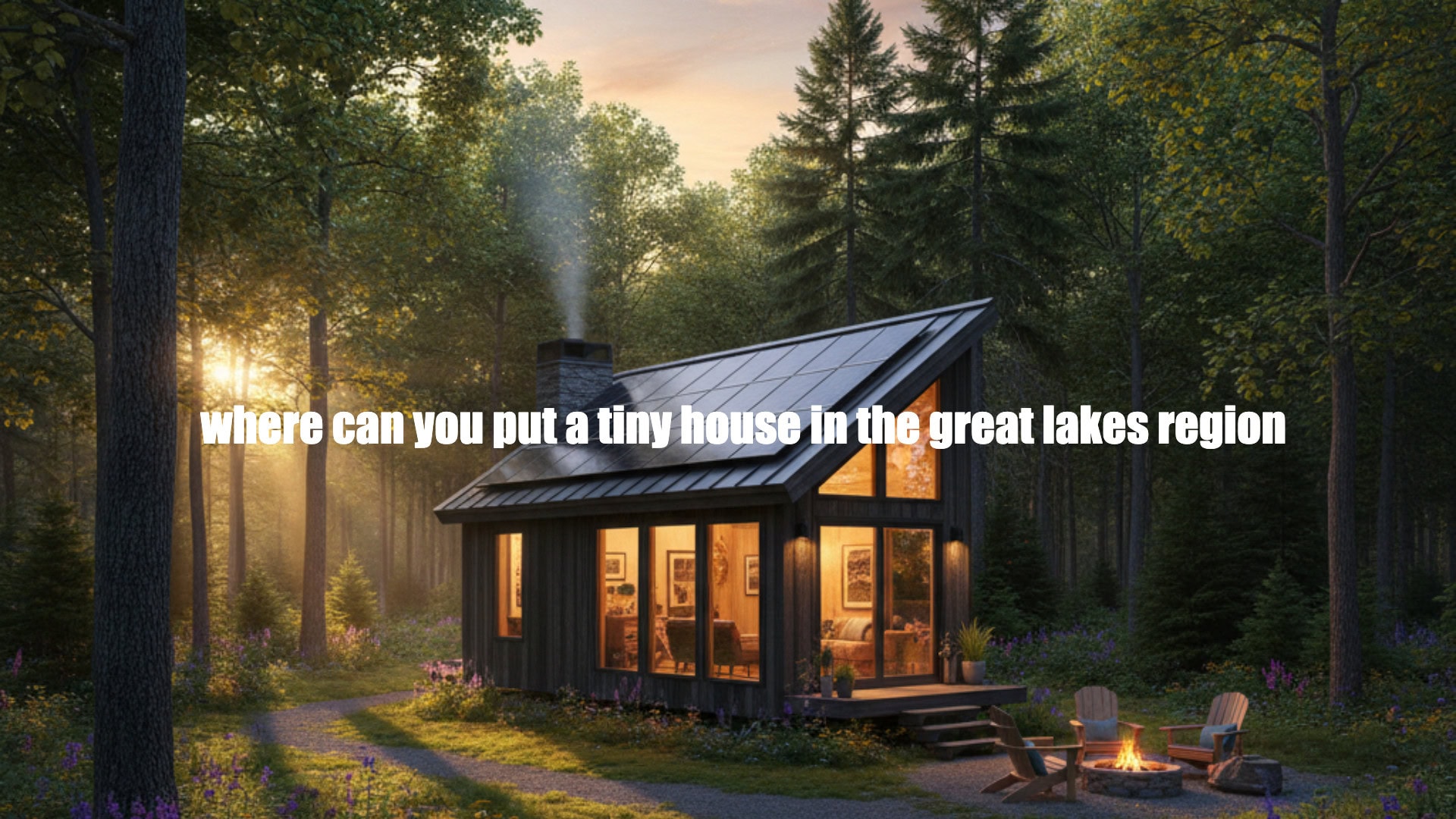
The Great Lakes region permits tiny houses primarily in RV parks for RVIA-certified wheeled units, established tiny house communities, private agricultural or rural land with appropriate zoning, and as accessory dwelling units (ADUs) on family properties in select municipalities. State-specific regulations require minimum living areas of 120 to 200 square feet for permanent foundation-based structures, with compliance to local building codes essential for legal placement. Wheeled tiny homes are treated as recreational vehicles, offering greater flexibility but restrictions on year-round residency in some areas.
The tiny house movement continues to gain momentum across the Great Lakes region, encompassing Michigan, Ohio, Illinois, Indiana, Wisconsin, Minnesota, Pennsylvania, and New York, where individuals seek sustainable and affordable living options amid rising housing costs. This guide explores where you can put a tiny house in the Great Lakes region, detailing legal placement options, state-by-state regulations, zoning considerations, and practical steps for successful implementation. Whether you’re envisioning a lakeside retreat or an urban-adjacent setup, understanding the region’s diverse regulatory landscape is key to turning your vision into reality.
Navigating these rules involves a mix of state building codes, local zoning ordinances, and utility requirements that can vary significantly even within counties. From RV parks offering immediate hookups to private land providing long-term autonomy, opportunities abound for those prepared to research and comply. At Great Lakes Tiny Homes, we specialize as a full-service manufacturer of modular, park model, and tiny homes, delivering turnkey builds to all 48 lower U.S. states with options for wheels or foundations, and with or without RVIA certification—our park models with RVIA certification maximize placement versatility across jurisdictions.
Ready to explore your options? Book a call with our experts to discuss tailored solutions for the Great Lakes region.
Disclaimer: This article is for informational purposes only and does not constitute legal advice. Laws, regulations, and zoning rules vary by location and may change over time. Always consult your local zoning office or a qualified land use/zoning attorney before making decisions based on this information.
Legal Placement Options for Tiny Houses in the Great Lakes Region
Determining where you can put a tiny house in the Great Lakes region starts with identifying legal placement categories that align with your lifestyle and location preferences. These options range from structured communities with built-in support to independent private land setups, each governed by specific zoning and code requirements. Understanding these pathways helps avoid common pitfalls like unintended code violations or utility access issues that could delay your project.
Tiny house communities and villages stand out as the most accessible entry point, featuring pre-approved sites with shared amenities such as utilities, green spaces, and community events. These developments have already cleared local hurdles, making them ideal for newcomers to the movement. Private land zoned for agricultural or rural use offers greater privacy and customization, though it demands thorough verification of setbacks, septic approvals, and access rights. For those seeking flexibility, RV parks accepting tiny homes provide short- or long-term solutions with full hookups, particularly beneficial for RVIA-certified models.
Backyard accessory dwelling units (ADUs) on family property have surged in popularity as states update ordinances to encourage multigenerational living and housing density. Rural agricultural land often imposes the fewest restrictions, allowing structures outside traditional residential codes if tied to farming activities. Temporary camping permits serve as bridges for transitional living, typically valid for 30 to 180 days while securing permanent spots. Each option requires site-specific due diligence to ensure compliance and sustainability.
Disclaimer: This article is for informational purposes only and does not constitute legal advice. Laws, regulations, and zoning rules vary by location and may change over time. Always consult your local zoning office or a qualified land use/zoning attorney before making decisions based on this information.
State-by-State Tiny House Regulations in the Great Lakes Region
The Great Lakes states have crafted distinct regulatory frameworks for tiny houses, reflecting local priorities around housing affordability, environmental protection, and urban density. This patchwork necessitates targeted research for each jurisdiction, as what works in one state may not apply across borders. Foundation-based tiny homes generally fall under residential building codes, while wheeled versions align with RV standards, influencing placement and occupancy rules.
Michigan Tiny House Regulations
Michigan permits tiny houses on wheels in RV parks when equipped with RVIA certification, treating them as recreational vehicles rather than permanent dwellings. For foundation installations, structures must adhere to the Michigan Residential Code, including a minimum of 120 square feet for single-occupancy units and compliance with ceiling height standards of at least 7 feet in habitable spaces. Permits are mandatory for all permanent setups, involving site plans, foundation inspections, and utility connections reviewed by local building departments. Rural areas like Leelanau County offer more leniency for ADUs, but urban zones such as Wayne County require stricter adherence to zoning setbacks and lot coverage limits. The Michigan Zoning Enabling Act empowers municipalities to regulate alternative housing, emphasizing the need for pre-approval consultations.
Recent updates in 2026 have expanded ADU allowances in select townships, allowing up to 800 square feet for attached or detached units on single-family lots, provided they share utilities with the primary residence. This shift supports aging-in-place strategies and supplemental income opportunities for homeowners. However, tiny houses intended for full-time residency must include energy-efficient features like R-19 wall insulation to withstand harsh winters. Owners should budget for ongoing compliance, including annual safety inspections in high-risk flood zones near the lakes.
Ohio Tiny House Regulations
Ohio’s approach to tiny houses is decentralized, with regulations handled at the county level and a statewide minimum of 150 square feet for permanent dwellings under the Ohio Building Code. RVIA-certified units find easy placement in approved RV parks, but foundation models require engineered plans and permits from local boards. Counties like Cuyahoga permit tiny houses in agricultural zones with reduced setback requirements, while urban areas enforce stricter lot size minima. The Ohio Administrative Code Chapter 4781-6 governs manufactured home installations, providing a framework for park model tiny homes on private property.
In 2026, several counties have adopted progressive ADU ordinances, capping units at 1,000 square feet and mandating owner-occupancy of the primary home. This facilitates backyard placements but prohibits short-term rentals in residential districts to preserve neighborhood character. Utility tie-ins, such as septic systems compliant with Ohio EPA standards, add complexity and cost, often ranging from $10,000 to $20,000. Prospective owners in rural Preble County benefit from flexible zoning that views tiny houses as farm accessory structures, easing approval processes.
Illinois Tiny House Regulations
Illinois mandates minimum ceiling heights of 6 feet 8 inches in living areas and 6 feet 4 inches in kitchens and bathrooms for tiny houses, per the Illinois Energy Conservation Code. Foundation requirements differ by county, with some accepting pier-and-beam systems while others demand full basements in frost-prone areas. Public Act 104-0341 facilitates tiny homes for at-risk veterans, exempting them from certain size restrictions if built to code. The Public Act 104-0341 outlines permit processes for such projects, emphasizing accessibility features.
ADUs are increasingly permitted in suburban counties, limited to 40% of the primary home’s footprint and requiring shared driveways for access. In 2026, updates to the Chicago Metropolitan Agency for Planning guidelines encourage compatible exterior designs to blend with existing neighborhoods. Septic and water approvals from the Illinois EPA are critical, particularly in unincorporated areas lacking municipal services. Tiny house owners must also consider flood zone designations near Lake Michigan, incorporating elevated foundations where mandated.
Indiana Tiny House Regulations
Indiana classifies tiny houses under both RV and residential codes based on mobility, with a 120 square foot minimum for single-occupancy permanent units. Rural counties provide broader flexibility, allowing off-grid setups in agricultural zones if equipped with approved waste systems. The Washington County Building Commissioner guidelines require HUD labels for manufactured tiny homes, ensuring structural integrity.
Columbus city’s 2023 FAQ highlights no minimum living area in tiny home communities but mandates 4,000 square foot lots per site for spacing. 2026 amendments have streamlined ADU permits in urban areas, capping sizes at 600 square feet and prohibiting separate utility meters to simplify billing. Fire safety features, like smoke detectors and egress windows, are non-negotiable statewide. In flood-vulnerable southern Indiana, elevated placements become essential for insurance eligibility.
Wisconsin Tiny House Regulations
Wisconsin’s regulations favor rural placements, with wheeled tiny houses allowed in RV parks and foundation units following the Uniform Dwelling Code’s 120 to 200 square foot range. The SPS 320.04 delegates enforcement to municipalities, leading to varied ADU policies. Sawyer County requires 500 square feet minimum for new homes, excluding most tiny houses from standard subdivisions.
Progressive ordinances in 2026 have introduced tiny home overlay districts in select townships, permitting clusters of up to 10 units on 5-acre parcels with communal septic. Energy codes demand high-efficiency windows and insulation to combat lake-effect snow. Milwaukee’s zoning updates allow limited ADUs, but only if architecturally harmonious with the primary structure. Owners in northern Wisconsin must address bear-proofing and wildfire risks in forested zones.
Minnesota Tiny House Regulations
Minnesota requires tiny houses to meet either RV standards or the 2020 Residential Code, with 150 square feet minimum for permanent dwellings and RVIA certification for park placements. The Minnesota Department of Labor and Industry’s Tiny Houses Guide clarifies that prefabricated units must comply with Chapter 1360 rules. ADUs are restricted to lots with existing single-family homes, emphasizing shared ownership.
In 2026, Duluth’s policies allow detached ADUs up to 800 square feet on platted lots, provided they connect to city water and sewer. Ceiling heights of 6 feet 8 inches apply, with lofts counting toward floor area if accessible. Off-grid options in rural Itasca County require solar permits and composting toilets approved by the MDA. Harsh winters necessitate heated entryways and insulated pipes to prevent freezing.
Pennsylvania Tiny House Regulations
Pennsylvania’s municipal variations set a 140 square foot minimum for permanent tiny houses, with rural areas more accommodating than urban centers. The PA Department of Community & Economic Development’s Manufactured Housing Program mandates HUD installer licenses for wheeled units. ADUs face county-specific caps, often 50% of the primary home’s size.
2026 zoning reforms in Allegheny County permit tiny homes as interim housing in designated districts, requiring on-site bathrooms and utilities. Modular certifications under the Industrialized Housing Act ensure compliance for factory-built models. Floodplain management near Lake Erie demands elevated foundations and sump pumps. Equity considerations in low-income areas encourage community land trusts for shared ownership.
New York Tiny House Regulations
New York’s regulations diverge sharply between rural and urban settings, mandating 150 square feet for permanent dwellings and RVIA certification for campgrounds. The Plus One ADU Program supports conversions statewide with low-interest loans. Urban zones like NYC restrict tiny homes to ADUs on owner-occupied lots.
2026 updates to the Residential Code include Appendix BB for tiny houses, defining units under 400 square feet with adjusted egress rules. Rural Sullivan County allows seasonal tiny homes without full foundations, but year-round requires frost-protected slabs. Snow load capacities of 50 psf are standard in upstate areas. The program prioritizes affordability, capping rents at 30% of area median income for funded projects.
Disclaimer: This article is for informational purposes only and does not constitute legal advice. Laws, regulations, and zoning rules vary by location and may change over time. Always consult your local zoning office or a qualified land use/zoning attorney before making decisions based on this information.
Key Locations for Tiny Houses in the Great Lakes Region
| County/City | Min Sq Ft | Zoning Type | Key Requirements | Source | Verified |
|---|---|---|---|---|---|
| Wayne County | 120 | Agricultural/RV | RVIA certification for wheels; ADU on family lots | Michigan Zoning Enabling Act | Yes |
| Cuyahoga County | 150 | Residential/ADU | County approval for foundations; setbacks 10 ft | Ohio Admin Code Ch. 4781-6 | Yes |
| Cook County | N/A for ADUs | ADU | Compatible exteriors; shared utilities | CMAP ADU Guide | Yes |
| Washington County | 120 | Manufactured | HUD label required | Washington County Building Commissioner | Yes |
| Sawyer County | 500 | Rural | 20×20 ft min dimensions | Sawyer County Building Guide | Yes |
| Hennepin County | 150 | Residential | RV or code compliance | MN DLI Tiny Houses | Yes |
| Allegheny County | 140 | Municipal | Installer license for manufactured | PA DCED Manufactured Housing | Yes |
| Erie County | 150 | ADU | Appendix BB for tiny houses | NY Plus One ADU | Yes |
Disclaimer: This article is for informational purposes only and does not constitute legal advice. Laws, regulations, and zoning rules vary by location and may change over time. Always consult your local zoning office or a qualified land use/zoning attorney before making decisions based on this information.
Tiny House Regulations in Major Great Lakes Cities
Major cities in the Great Lakes region present unique opportunities and challenges for tiny house placement, shaped by dense populations, historic preservation efforts, and innovative housing policies. Urban zoning often prioritizes ADUs to increase density without altering skylines, while industrial zones occasionally host tiny home villages for workforce housing. These metros balance affordability initiatives with infrastructure constraints, requiring applicants to engage city planning departments early in the process. Recent 2026 ordinances reflect a growing acceptance of tiny houses as solutions to homelessness and multigenerational needs.
City-specific rules emphasize integration with existing neighborhoods, mandating design reviews and utility upgrades to support sustainable living. Flood risks from lake proximity influence foundation standards, with elevated or flood-resistant designs commonplace. Community input plays a key role in approvals, fostering inclusive developments that enhance urban fabric. For those eyeing city placement, partnering with local architects familiar with code nuances proves invaluable.
Detroit, Michigan
Detroit’s tiny house regulations focus on revitalizing blighted areas through planned developments and ADUs, with Wayne County’s oversight allowing 120 square foot minima in residential zones. The city’s Planned Development districts permit tiny home shelters as interim housing, requiring PD zoning approvals and community benefit agreements. Recent 2026 expansions under the Zoning Ordinance enable backyard ADUs up to 600 square feet on lots over 5,000 square feet, provided they match the primary home’s architectural style. Utility connections to DTE Energy and Detroit Water must comply with lead-free standards, adding preparation time. The City of Detroit Tiny Home Shelter Zoning document outlines site plan reviews essential for multi-unit projects.
Detroit’s Motor City Makeover initiative integrates tiny houses into urban farms, waiving certain permits for agricultural adjuncts under 400 square feet. Fire safety mandates sprinklers in attached units, while detached ones need 10-foot separations from structures. Economic incentives like tax abatements encourage placements in opportunity zones, lowering long-term costs. Residents benefit from proximity to revitalized riverfronts, but noise ordinances in mixed-use areas require soundproofing considerations. Navigating these rules involves consultations with the Buildings, Safety Engineering, and Environmental Department for seamless approvals.
Chicago, Illinois
Chicago treats tiny houses primarily as ADUs under the Additional Dwelling Units Ordinance, allowing conversions or new builds up to 700 square feet in single-family zones without minimum size mandates beyond habitability. The city requires owner-occupancy of the primary residence and shared parking to minimize street congestion. 2026 updates facilitate detached ADUs in rear yards, capped at 60% lot coverage, with mandatory green roof elements for stormwater management. Electrical and plumbing permits from the Department of Buildings ensure compliance with Chicago Plumbing Code. The Chicago ADU Ordinance provides detailed application processes, including neighbor notifications.
In flood-prone areas like the South Side, tiny houses must incorporate sump pumps and elevated entries per FEMA guidelines. The program’s emphasis on affordability limits rents to 120% of area median income for five years post-construction. Historic districts demand Commission on Chicago Landmarks approval for visible alterations, preserving neighborhood aesthetics. Multi-unit pilots in Pilsen explore tiny home clusters for artists, blending zoning variances with cultural grants. Homeowners find value in generating rental income while addressing family caregiving needs through these flexible units.
Cleveland, Ohio
Cleveland’s regulations permit tiny houses as ADUs in residential districts, with no strict square footage minimum but requiring at least one habitable room of 120 square feet under the Ohio Building Code. The city’s Form-Based Code encourages contextual designs in legacy neighborhoods, allowing detached units up to 800 square feet on lots zoned R1 to R5. 2026 amendments streamline permits for infill developments, mandating energy audits for net-zero compliance. Cuyahoga County’s health department oversees septic for off-sewer sites, prioritizing percolation tests. The Cleveland Heights ADU Guidelines extend to broader metro, emphasizing self-contained utilities.
Industrial zones near the Cuyahoga River host tiny home worker villages, approved via special use permits with traffic impact studies. Preservation efforts in Shaker Heights restrict ADUs to rear placements, avoiding front-yard visibility. Economic development grants subsidize conversions in Opportunity Zones, reducing upfront costs by 20%. Winter resilience features like radiant floor heating become standard to handle lake-effect snow. Community land trusts in Slavic Village facilitate shared equity models, ensuring long-term affordability amid gentrification pressures.
Milwaukee, Wisconsin
Milwaukee classifies tiny houses under General Planned Development overlays, permitting developments like the Humboldt Boulevard project with units from 200 to 400 square feet in IL2 zones rezoned to GPD. The city’s 2026 zoning updates allow ADUs up to 750 square feet in residential areas, requiring compatibility with primary structures and shared driveways. Minimum ceiling heights of 7 feet apply, with lofts exempted if safely accessed. The Department of City Development reviews site plans for stormwater and green space integration. The Milwaukee Tiny Homes Zoning initiative details public hearing processes for approvals.
Riverwest neighborhood pilots emphasize eco-friendly materials, mandating solar readiness and native landscaping. Flood zone regulations near Lake Michigan demand BFE elevations, complicating basement conversions. Affordability covenants tie units to income-qualified buyers for 10 years, supporting workforce housing. Historic Third Ward restrictions limit ADU heights to one story, preserving waterfront views. Collaborative efforts with UW-Milwaukee explore modular prefabs, accelerating timelines while meeting Uniform Dwelling Code standards.
Minneapolis, Minnesota
Minneapolis regulates tiny houses through the Residential Code and ADU provisions, allowing units up to 1,000 square feet as accessory to single-family homes on lots over 4,000 square feet. The 2026 Intentional Communities Ordinance permits cluster developments of tiny homes in R districts, with shared amenities like communal kitchens. Foundation requirements include frost-protected shallow setups, with RVIA optional for movable units. The Minnesota DLI Tiny Houses Guide governs prefab compliance, ensuring seismic and wind resistance.
Northeast Minneapolis arts district variances allow artist live/work tiny homes, exempt from standard setbacks if noise-mitigated. Sustainability mandates include Energy Star appliances and permeable surfaces for runoff control. Hmong Village collaborations integrate cultural designs, fostering inclusive zoning. Winterization features like insulated skirts for wheels address sub-zero temps. The city’s Housing and Redevelopment Authority offers low-interest loans, easing entry for first-time owners in diverse neighborhoods.
Buffalo, New York
Buffalo’s Code Outreach Program clarifies tiny house rules, permitting units under 400 square feet without minimum size requirements in residential zones, provided they meet the 2025 Residential Code’s Appendix BB. ADUs require owner-occupancy and rear-yard placement, limited to 50% of primary footprint. 2026 expansions allow conversions of garages into tiny homes with separate entrances. The Department of Permits and Inspections handles electrical and plumbing reviews. The Buffalo Code Outreach Program – Tiny Houses provides zoning compliance checklists.
Fruit Belt neighborhood initiatives target vacant lots for tiny home infill, with community benefits like job training. Snow load designs of 60 psf ensure roof integrity during lake-effect storms. Historic preservation in Allentown mandates matching facades for visible ADUs. Erie Canal Harbor developments explore floating tiny homes, pending waterfront variances. Affordability programs cap construction costs at $150,000 through state grants, revitalizing post-industrial areas.
Pittsburgh, Pennsylvania
Pittsburgh’s 2026 zoning bill advances tiny homes for homeless support, allowing clusters in special districts with on-site facilities and local approvals. ADUs in residential zones reach 900 square feet, requiring two per lot maximum and primary home occupancy. The Uniform Construction Code sets room minima at 120 square feet, with modular units needing PA Insignia certification. Allegheny County’s planning commission oversees variances for sloped terrains. The Pittsburgh City Council Tiny Homes Bill outlines interim housing standards.
Lawrenceville’s innovation district pilots tiny home pods for tech workers, integrating smart home tech. Flood controls along the Allegheny River mandate elevated platforms and backup generators. Historic Shadyside limits ADUs to basements or attics, preserving streetscapes. Urban Redevelopment Authority subsidies cover 30% of costs for low-income projects. Collaborative designs with Carnegie Mellon emphasize resilient materials against rust belt weather.
Disclaimer: This article is for informational purposes only and does not constitute legal advice. Laws, regulations, and zoning rules vary by location and may change over time. Always consult your local zoning office or a qualified land use/zoning attorney before making decisions based on this information.
Best Tiny House Communities in the Great Lakes Region
Established tiny house communities in the Great Lakes region simplify placement by pre-negotiating zoning and providing essential infrastructure, fostering supportive environments for sustainable living. These villages often feature eco-friendly designs, shared resources, and proximity to natural amenities like lakeshores and trails. Selection criteria include lot availability, utility reliability, and community governance, ensuring long-term viability. In 2026, demand has spurred expansions, with waitlists common in popular spots.
Communities vary from waterfront retreats to inland eco-villages, each tailored to regional climates with features like communal solar arrays and composting facilities. Resident involvement in rule-making promotes harmony, while events build social bonds. For those considering Best Tiny Home Communities in Michigan, options abound near the lakes. Costs typically range $350-700 monthly, covering maintenance and access to perks like workshops and gardens.
Tiny House Village at Lake Michigan (Michigan)
Situated along Lake Michigan’s dunes, this 25-lot community accommodates wheeled and park model tiny houses with RVIA certification, offering a community center, organic gardens, and direct beach access. Monthly fees of $400-600 include water, sewer, and electricity, with fiber optic internet available. Rules emphasize low-impact living, prohibiting gas grills and requiring native plant landscaping. Expansions in 2026 added EV charging stations, appealing to eco-conscious residents. Proximity to Traverse City provides urban conveniences without sacrificing tranquility.
Prairie Wind Tiny House Community (Illinois)
Spanning 20 acres in rural McHenry County, Prairie Wind features 40 lots with hiking trails, a shared workshop, and apiary for pollinator support. Rentals at $350-500 monthly leave utilities to residents, accommodating both foundation and wheeled units up to 400 square feet. Community bylaws promote self-sufficiency, with mandatory recycling and solar incentives. 2026 enhancements include a permaculture farm, supplying fresh produce to members. The site’s rolling prairies offer stunning sunsets, ideal for nature enthusiasts.
Woodland Tiny House Village (Ohio)
Nestled in Ohio’s Appalachian foothills, this 30-lot village provides full hookups and amenities like a pavilion and fire pits, with fees from $450-650. Homes must meet aesthetic guidelines for cohesion, accepting certified models under 500 square feet. Governance via resident council ensures fair lot assignments and dispute resolution. Recent additions feature a wellness center with yoga space, enhancing quality of life. Access to Hocking Hills state parks enriches outdoor pursuits.
For more community insights, explore Best Tiny Home Communities in Ohio.
Placing Your Tiny House on Private Land
Private land offers unparalleled freedom for tiny house owners in the Great Lakes region, but success hinges on meticulous zoning verification and infrastructure planning. Rural parcels zoned agricultural typically allow alternative structures with fewer restrictions, ideal for off-grid aspirations. Urban fringe lots may qualify for ADUs, provided they meet density thresholds and neighbor buffers. Early engagement with township assessors prevents surprises like inherited easements or wetland designations.
Site selection involves soil tests for foundations and percolation for septics, crucial in clay-heavy soils common to the region. Budget for professional surveys to confirm boundaries and elevations, avoiding encroachments. In considering Tiny House For Sale Michigan, factor in resale potential tied to compliant builds. Long-term stewardship plans, like conservation easements, can yield tax benefits while preserving natural features.
Zoning Verification begins with county planning offices, where digital maps reveal permitted uses and variance histories. Agricultural zones often bypass residential minima, but conditional uses may require public hearings. Flood insurance maps from FEMA guide safe placements, mandating elevations above base flood levels.
Utility Connections demand feasibility studies; wells in glacial till can cost $5,000-20,000, while grid ties average $3,000-10,000 for electrical. Septic designs per state health codes range $7,000-18,000, with engineered systems for poor soils. Off-grid solar setups, popular in remote Upper Peninsula spots, require net metering approvals for excess power sales.
Building Permits entail submitting sealed drawings, fees of $600-2,500, and phased inspections for framing, plumbing, and finals. Some jurisdictions accept third-party inspections for modulars, speeding timelines. Annual property taxes on tiny houses average $500-1,500, lower in rural valuations.
Disclaimer: This article is for informational purposes only and does not constitute legal advice. Laws, regulations, and zoning rules vary by location and may change over time. Always consult your local zoning office or a qualified land use/zoning attorney before making decisions based on this information.
Understanding Zoning Laws and Permit Requirements
Zoning laws in the Great Lakes region classify land uses to balance growth with preservation, directly impacting tiny house feasibility. Residential zones enforce code-compliant dwellings, often excluding wheeled units from permanent status. Agricultural designations provide leeway for farmstead adjuncts, viewing tiny houses as worker housing. Variances offer exceptions but involve hearings and fees, succeeding with demonstrated hardships like economic need.
Permit timelines span 45-120 days, starting with pre-application meetings to align on requirements. Digital submissions via county portals streamline reviews, though rural offices may lag. Appeals processes exist for denials, typically within 30 days to zoning boards. For builder guidance, see Tiny House Builder Chicago.
Residential Zoning demands IRC adherence, including 200-amp service and egress-compliant windows. Lot coverage caps at 35% in suburban areas, limiting multi-unit setups.
Agricultural Zoning permits non-conforming structures if secondary to primary ag uses, like equipment sheds doubling as dwellings. Multi-family allowances support farm labor housing.
RVIA Certification Benefits reclassify units as RVs, evading residential codes for park or temporary placements. Annual recertifications ensure safety, costing $200-500.
The process unfolds with staff consultations, plan submittals, public notices if needed, issuance, and inspections at key milestones. Complex projects like sloped sites may require geotechnical reports.
Disclaimer: This article is for informational purposes only and does not constitute legal advice. Laws, regulations, and zoning rules vary by location and may change over time. Always consult your local zoning office or a qualified land use/zoning attorney before making decisions based on this information.
RV Parks and Campgrounds That Accept Tiny Houses
RV parks across the Great Lakes region have adapted to welcome tiny houses, especially RVIA-certified models under 400 square feet, providing hookups and community without ownership hassles. Seasonal options suit snowbirds, while year-round sites cater to full-time residents. Capacities vary, with 30/50-amp service standard and pull-through spots for easy access. 2026 trends show increased pet-friendly policies and glamping add-ons like fire rings.
Park selection involves reviewing length restrictions and quiet hours, essential for harmonious living. Long-term leases often include storage rights, mitigating off-season concerns. In exploring options, consider Tiny House For Sale Ohio for nearby purchases.
Michigan Options feature Petoskey RV Resort’s lakeside sites at $450-600 monthly, accepting certified units with clubhouse access. Warren Dunes State Park’s seasonal spots near beaches run $400-500, requiring reservations amid high demand.
Ohio and Illinois Facilities include East Harbor State Park’s Lake Erie sites at $350-450, with fishing piers. Chain O’Lakes offers wooded utilities for $400-550, emphasizing family activities.
Wisconsin and Minnesota Parks range from Devil’s Lake’s basic $300-400 sites to Gull Lake’s premium lakefronts at $400-600. All mandate certification and vehicle tags, with Minnesota adding composting toilet approvals.
Disclaimer: This article is for informational purposes only and does not constitute legal advice. Laws, regulations, and zoning rules vary by location and may change over time. Always consult your local zoning office or a qualified land use/zoning attorney before making decisions based on this information.
Tiny House Prices in the Great Lakes Region
Tiny house prices in the Great Lakes region fluctuate based on size, with smaller 200-square-foot models starting lower than expansive 400-square-foot designs offering lofts and decks. Foundation options command premiums over wheeled counterparts due to permanence and code compliance, while RVIA certification adds $5,000-10,000 for versatility in parks. Utility hookups influence totals, as rural off-grid setups save on connections but require solar investments of $10,000+. Local codes may necessitate upgrades like reinforced roofs for snow loads, pushing costs in northern states.
Regional labor and material rates vary, with Midwest manufacturing hubs like Indiana offering competitive builds compared to coastal New York. Customization for climate resilience, such as enhanced insulation, typically adds 15-20% to base prices. Resale values hold strong in eco-conscious communities, appreciating with green certifications. Budgeting should allocate 20% for permits and site prep, ensuring financial feasibility.
At Great Lakes Tiny Homes, our builds range from $100,000 to $150,000 for turnkey deliveries, encompassing modular and park model options customized for regional needs. We handle everything from design to installation, ensuring compliance with local codes across the eight states.
Our model lineup includes:
- Modular Homes – Ideal for foundation placements in residential zones, offering expandable layouts.
- A-Frame – Suited for snowy areas with steep roofs for shedding accumulation.
- Cabin – Rustic designs fitting agricultural zoning, with wood finishes evoking regional heritage.
- Park Models – RVIA-certified for park flexibility, maximizing mobility.
- Tiny House on Wheels – Perfect for transitional or rural spots, easy to relocate.
Model selection should align with zoning—wheeled for RV areas, modular for permanent sites—to optimize compliance and longevity. Zoning impacts like foundation mandates can influence choices, favoring certified wheels in restrictive municipalities.
If zoning complexities arise, our team can guide selections for your scenario. Book a call with our experts for personalized advice.
Disclaimer: This article is for informational purposes only and does not constitute legal advice. Laws, regulations, and zoning rules vary by location and may change over time. Always consult your local zoning office or a qualified land use/zoning attorney before making decisions based on this information.
Utilities and Infrastructure Requirements
Reliable utilities form the backbone of tiny house living in the Great Lakes region, where seasonal extremes demand robust systems for water, power, and waste. Municipal connections suit urban edges, costing $1,500-6,000 upfront plus monthly fees, while rural alternatives like wells and septics involve higher initial outlays but lower ongoing expenses. Solar integration grows popular, offsetting grid reliance amid rising energy costs. Planning must account for county health approvals, ensuring potable water and safe effluent disposal.
Infrastructure scalability allows starting small and expanding, such as adding battery storage for blackouts common during storms. Greywater recycling reduces loads on septics, aligning with sustainability goals. For Tiny House Builder Wisconsin, utilities factor into custom designs. Maintenance schedules, like annual well tests, prevent costly failures in hard water areas.
Water Connections options include city hookups at $1,000-5,000 plus $30-80 bills, private wells $3,000-15,000 with pumps $1,500-3,000, and rainwater systems needing filtration for potability.
Electrical and Sewage Systems feature 30-amp for basics at $2,000-5,000 or 50-amp $3,000-8,000; sewage via municipal $1,500-4,000 plus fees or septics $5,000-15,000.
Off-Grid Alternatives encompass solar $8,000-20,000 and rainwater $1,000-5,000, with wind turbines viable near lakes for hybrid power.
Disclaimer: This article is for informational purposes only and does not constitute legal advice. Laws, regulations, and zoning rules vary by location and may change over time. Always consult your local zoning office or a qualified land use/zoning attorney before making decisions based on this information.
Great Lakes Region Climate Considerations for Tiny House Living
The Great Lakes’ microclimates challenge tiny house designs, with lake-effect snow exceeding 100 inches annually in upstate New York and humid summers fostering mold in Ohio valleys. Insulation strategies like SIPs achieve R-30 walls, minimizing heating needs during -20°F winters. Ventilation systems with HRVs maintain air quality, crucial in airtight envelopes. Site orientation maximizes passive solar, reducing reliance on propane or electric backups.
Material choices favor durable exteriors like fiber cement siding resistant to salt air corrosion near shores. De-icing roofs prevents collapses under heavy loads, while foundation drains combat frost heaves. In southern Indiana, AC units sized for 95°F peaks ensure comfort. Monitoring tools like smart thermostats optimize efficiency, cutting bills by 30%.
Winter Weather Management tackles freezes with R-20 to R-30 walls and R-40 to R-50 roofs, plus heated hoses for exterior faucets.
Heating and Cooling Systems include mini-splits for mild areas, propane furnaces for extremes, and AC for humid zones.
Moisture and Snow Management employs exhaust fans, vapor barriers, and 30-50 psf roof designs with metal sheeting.
Common Challenges and How to Overcome Them
Tiny house projects in the Great Lakes face hurdles like regulatory flux and supply chain delays, but proactive strategies mitigate risks. Zoning ambiguities arise from overlapping state and local rules, resolvable through attorney reviews early on. Land scarcity near waters drives creative financing like co-ops. Climate adaptations, while costly, yield savings via efficiency rebates.
Community resistance can stall variances; educational town halls build support. Financing gaps close with RV loans at 5-7% rates for certified units. For solutions, consult Best Tiny Home Communities in Illinois. Iterative planning refines designs, ensuring resilience.
Navigating Complex Zoning Laws
Start with planning department visits for ordinance interpretations, securing written verifications. Hire zoning consultants for variance applications, citing precedents like ADU successes. Track legislative updates via state housing portals to anticipate changes.
Finding Suitable Land or Communities
Broaden searches to exurban areas, using GIS tools for zoning overlays. Join regional Facebook groups for off-market leads. Pool resources for group buys on larger tracts.
Meeting Building Code Requirements
Collaborate with code-savvy builders, opting for RVIA to sidestep residential hurdles. Pursue variances with engineering justifications for deviations.
Securing Financing
Leverage RV loans for wheels, construction lines for foundations, and builder financing packages. Explore USDA rural development grants for eligible sites.
Frequently Asked Questions About Tiny House Placement in the Great Lakes Region
Can I Live in a Tiny House Year-Round in the Great Lakes Region?
Yes, provided the tiny house complies with local codes for insulation, utilities, and foundations suitable for permanent occupancy. RVIA-certified units enable year-round RV park living, while foundation models qualify as residences with proper permits. Harsh winters necessitate robust heating, but many thrive full-time with adaptations like wood stoves.
What’s the Difference Between Tiny Houses and RVs Legally?
Tiny houses on foundations are dwellings under building codes, allowing permanent use but requiring inspections. RV-classified tiny homes with certification park in recreational areas but face occupancy limits in some states. Hybrids like park models bridge both, offering code flexibility.
How Much Does It Cost to Place a Tiny House?
Expect $300-700 monthly for community lots with utilities, $15,000-50,000 upfront for private land utilities and permits, plus $250-600 for RV parks. Tiny house builds range $60,000-200,000, with transport/setup $2,000-8,000. Total investments vary by permanence and location.
Do I Need Special Insurance for My Tiny House?
RV policies cover $500-1,500 annually for certified units, while homeowners’ $800-2,000 suit foundations. Specialized tiny home insurers address unique risks like mobility and small footprints. Bundle with land policies for comprehensive protection.
Your Next Steps to Tiny House Living in the Great Lakes Region
The Great Lakes region’s diverse landscapes—from Michigan’s dunes to Pennsylvania’s hills—host myriad tiny house possibilities, matching budgets from rental lots to owned acres. Prioritize regulatory research via state housing sites and local offices to pinpoint viable spots. Evaluate lifestyle fit: communities for social ties, private land for solitude. Factor climate prep into budgets for enduring comfort.
Network through meetups and online forums for insider tips on hidden gems. Secure pre-approvals for financing tied to compliant designs. Track progress with checklists covering permits to move-in. For ownership paths, review Tiny House For Sale Minnesota.
Thorough due diligence transforms challenges into triumphs, yielding simplified lives amid natural beauty. Embrace the journey with informed steps toward independence.
Ready to proceed? Book a call with our experts who have guided hundreds through regional placements.
How Great Lakes Tiny Homes Supports Great Lakes Region Placement
Our regional expertise spans the eight states’ codes, from Michigan’s RV flexibilities to New York’s ADU incentives, streamlining approvals for clients. We navigate variances and inspections, averting delays through pre-submittal reviews. Builds incorporate lake climates, with vapor barriers and high R-values standard.
Customization aligns with zoning—wheels for parks, foundations for permanence—while guidance covers site selection and contractors. Comprehensive services include regulatory scouting and hookup coordination. For builder options, see Tiny House Builder Pennsylvania.
Quality craftsmanship exceeds codes, using Amish techniques for durability. From consultations to keys, we foster dreams into homes. Book a call with our experts for bespoke support.