
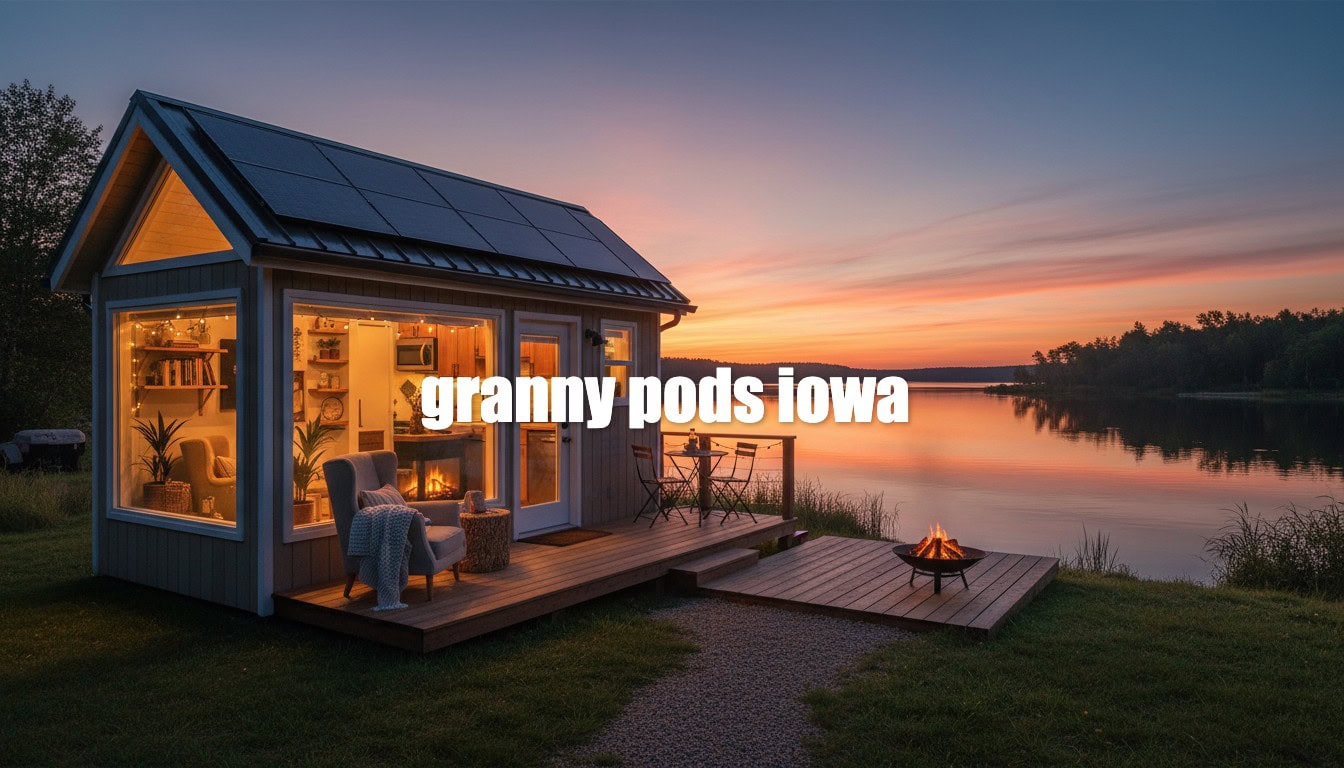
As you navigate the challenges of caring for aging family members in Iowa, granny pods emerge as a versatile and compassionate housing solution. These compact, self-contained units allow your elderly relatives to live nearby while preserving their autonomy. With Iowa’s growing senior population and the high costs of traditional care facilities, you’re likely seeking affordable ways to keep family close. Granny pods, often resembling tiny homes, provide a practical alternative right in your backyard.
In the context of Iowa’s emphasis on family values and rural living, granny pods align perfectly with the need for accessible, cost-effective elder care. They offer relevance by integrating seamlessly into your property, supporting multigenerational households amid the state’s harsh winters and expansive landscapes. For credibility, companies like Great Lakes Tiny Homes specialize in crafting these units as tiny houses, giving you options for wheeled or stationary models, with or without RVIA certification for park model compliance, ensuring they meet your specific needs without hassle.
What Are Granny Pods?
You might wonder what exactly granny pods are and why they’re gaining traction in Iowa. Granny pods are small, detached dwelling units designed specifically for aging relatives, allowing them to reside close to your family home while enjoying their independence. Typically, these units range from 300 to 800 square feet, featuring essential living spaces like a bedroom, bathroom, kitchenette, and living area.
In Iowa, their popularity stems from the state’s aging demographic—over 17% of residents are 65 or older, according to recent census data—and the desire to avoid the isolation of distant care facilities. You can envision installing one on your property in Des Moines or Cedar Rapids, providing peace of mind during Iowa’s long winters when mobility can be challenging. Great Lakes Tiny Homes offers granny pods in the form of tiny houses, where you choose between models on wheels for easier relocation or permanent foundations. Additionally, opting for RVIA certification turns them into park models, which often simplify zoning approvals in recreational or residential areas. This flexibility makes them ideal for your Iowa lifestyle, blending modern convenience with familial support. For instance, consider a scenario where your parent needs occasional assistance but values privacy; a granny pod allows you to monitor subtly through shared walkways or windows, enhancing daily interactions without intrusion.
Historically, the concept evolved from accessory dwelling units (ADUs) in the 1980s, but in Iowa, they’ve adapted to local needs like energy-efficient designs to combat cold snaps. As you explore options, consider how a granny pod can foster daily interactions—perhaps sharing meals or garden time—without sacrificing privacy. For those interested in tiny house for sale Iowa, these units represent a smart investment in family well-being. Moreover, integrating sustainable features like rainwater collection systems can further align with Iowa’s eco-conscious rural ethos, reducing long-term environmental impact.
Inside the Modern Granny Pod: Features, Design, and Purpose
When you delve into the world of granny pods, also known as accessory dwelling units or ADUs, you’ll find they’re engineered for comfort and functionality, especially for seniors. These structures typically span 300 to 800 square feet, offering a cozy yet complete living environment. You can expect amenities like a compact kitchen with energy-efficient appliances, a full bathroom, one or two bedrooms, and open living spaces that maximize natural light.
What sets granny pods apart are their senior-friendly designs. Unlike standard tiny homes focused on minimalism, these prioritize accessibility: think zero-step entries to ease mobility, wider doorways for wheelchairs, and grab bars in bathrooms. You might incorporate medical monitoring features, such as built-in alert systems or smart thermostats that track health metrics, ensuring your loved one’s safety without constant oversight. These technologies, like automated lighting that adjusts to movement, can prevent accidents in low-visibility Iowa evenings.
Types vary to suit your preferences—prefab models arrive ready-to-assemble, saving you time; custom-built options let you tailor layouts to Iowa’s terrain; converted structures, like shipping containers, offer eco-friendly alternatives. For elderly relatives, the purpose shines through in elements like non-slip flooring, adjustable-height counters, and ample storage to reduce clutter. In Iowa’s variable climate, insulated walls and high-efficiency windows keep interiors warm and draft-free. A real-world example might involve a family in Sioux City using a prefab pod with heated floors to maintain comfort during sub-zero temperatures, demonstrating practical resilience.
Imagine your parent enjoying a private space with a small deck for birdwatching, connected yet separate from your main home. This design not only supports independence but also integrates seamlessly, perhaps matching your home’s siding for aesthetic harmony. If you’re researching best tiny home communities in Iowa, granny pods extend that community feel to your own backyard. Additionally, incorporating passive solar design can optimize natural heating, a boon for energy savings in the Midwest.
Benefits of Granny Pods for Iowa Families
For Iowa families like yours, granny pods bring a host of advantages that resonate with the state’s close-knit culture and practical mindset. First, they enable proximity for care and support—you can check in daily without the logistics of separate households, crucial during Iowa’s snowy winters when travel is tough.
Independence remains key; your elderly relative enjoys their own space, fostering dignity and reducing resentment common in shared homes. Financially, they’re a boon: average nursing home costs in Iowa exceed $7,000 monthly, per Genworth data, while a granny pod runs $100,000 to $150,000 upfront via builders like Great Lakes Tiny Homes. Over time, this yields massive savings compared to assisted living fees averaging $4,500 monthly. For example, a family in Cedar Rapids might recoup their investment within three years through avoided care costs, allowing funds for other family needs.
Property value also rises—adding a granny pod enhances your home’s appeal as a multigenerational haven, recouping your investment and more upon resale. Emotionally, keeping family close combats Iowa’s rural isolation, where 30% of seniors live alone. The state’s heartland values shine here, with pods allowing shared holidays and support networks. Health benefits include reduced stress for caregivers, as studies show proximity lowers depression rates by 25% in multigenerational setups.
Climate-wise, Iowa’s four seasons demand sturdy builds, but granny pods’ efficiency cuts utility bills by up to 40%. With the aging population projected to hit 20% by 2030, you’re future-proofing your family. Versus assisted living’s cumulative $500,000+ over a decade, your $100k-$150k spend retains value as a tangible asset, not ongoing expenses. Explore how this fits with what counties in Iowa allow tiny houses for localized benefits. Furthermore, these units can adapt for future uses, like guest spaces, adding versatility to your property.
Legal Considerations for Granny Pods in Iowa
Navigating the legal landscape for granny pods in Iowa requires your attention to state and local rules, as regulations vary widely. At the state level, Iowa follows general building codes under the International Residential Code (IRC), but granny pods as ADUs fall under zoning ordinances managed by counties and cities.
Zoning laws often classify them as accessory structures, requiring them to be secondary to your primary residence. You must secure permits for construction, utilities, and occupancy—expect inspections for safety and septic compliance. In urban areas like Des Moines (Polk County), ADUs are permitted in residential zones with setbacks of 5-10 feet from property lines. Rural counties like Story or Johnson are more lenient, allowing them on agricultural lots with minimal restrictions. Understanding these nuances helps you avoid fines; for instance, non-compliance in urban zones can lead to removal orders.
Stricter spots include Dubuque (Dubuque County), where size caps at 800 sq ft and owner-occupancy is mandated. Recent changes, like House File 2643 in 2022, eased some rural zoning for small dwellings, and pending bills aim to standardize ADU approvals statewide. For smoother compliance, RVIA-certified park models benefit from RV park zoning allowances, bypassing some foundation requirements and treating them as movable units—ideal if you’re in a restrictive municipality. This approach has helped many Iowa families in transitional areas like the Quad Cities navigate approvals efficiently.
This certification ensures adherence to federal standards, reducing permit hurdles and insurance costs. To demystify this, book a call with our experts who’ve helped hundreds of customers make their tiny home dreams a reality. Linking to tiny house builder Iowa resources can further guide your compliance. Always document your process, as variances may require proof of familial need.
Which Iowa Counties Allow Granny Pods?
To help you decide where to install your granny pod, here’s a comprehensive overview of Iowa counties’ stances. Focus on populated areas with clear policies:
| County Name | Granny Pod Status | Minimum Lot Size Requirements | Maximum Size Allowed | Special Notes |
|---|---|---|---|---|
| Polk (Des Moines) | Allowed | 0.5 acres | 800 sq ft | Des Moines city code permits ADUs in R-1 zones; must match primary home style. Utilities tie-in required. |
| Linn (Cedar Rapids) | Restricted | 1 acre | 600 sq ft | Case-by-case approval; no kitchens in detached units unless variance granted. Eastern Iowa focus on flood zones. |
| Scott (Davenport) | Allowed | 0.25 acres | 1,000 sq ft | Quad Cities area supportive; RVIA models accepted as temporary. Setback 6 ft from alleys. |
| Black Hawk (Waterloo) | Case-by-Case | 0.75 acres | 750 sq ft | Requires planning commission review; favorable for family caregiver units. Industrial history influences strict codes. |
| Woodbury (Sioux City) | Allowed | 1 acre | 900 sq ft | Western Iowa lenient on rural properties; septic permits essential due to Missouri River proximity. |
| Johnson (Iowa City) | Restricted | 0.5 acres | 500 sq ft | University town limits for student housing overlap; ADUs only for relatives, no rentals. |
| Dallas (West Des Moines) | Allowed | 0.4 acres | 800 sq ft | Suburban growth encourages; fast-track permits for energy-efficient builds. |
This table highlights key counties; always verify with local planning offices. For instance, in Polk County, Des Moines’ 2021 ordinance update streamlined ADU approvals, while Cuyahoga-like strictness isn’t an issue here—wait, Iowa specifics. Consult what counties in Iowa allow tiny houses for updates. Expanding on this, counties like Scott offer incentives for green builds, potentially reducing permit fees if your pod includes solar features.
Cost of Building a Granny Pod in Iowa
Building a granny pod in Iowa involves various costs, but you can budget effectively with a breakdown. Prefab units start at $80,000 for basic 400 sq ft models, while custom-built ones reach $200,000 for luxury finishes. Great Lakes Tiny Homes delivers quality tiny houses in the $100,000-$150,000 range, balancing affordability and durability.
Site preparation adds $5,000-$15,000, depending on whether your unit has wheels (minimal prep, just leveling) or requires a foundation (concrete slab at $10,000+ for no-wheel models, essential for permanent Iowa installs against frost heave). Utility connections—sewer, water, electric—cost $10,000-$20,000, higher in rural areas needing wells. Permits run $1,000-$5,000, varying by county. To illustrate, a wheeled model in rural Woodbury County might total under $120,000, including basic utilities, making it accessible for modest budgets.
Ongoing maintenance, like snow removal tools for Iowa winters, adds $500 yearly. Compared to nursing homes ($90,000/year average), your upfront investment saves $300,000+ over five years. Financing options include home equity loans at 6-8% interest or USDA rural development grants for Iowa properties. Energy-efficient upgrades, such as LED lighting and efficient HVAC, can qualify for rebates, further lowering net costs.
Insurance might increase your policy by 10-20%, but tax implications are favorable—ADUs can qualify for property tax abatements in progressive counties. Overall, versus assisted living’s $54,000 annual toll, your granny pod is a value-retaining asset. Factor in tiny house for sale Iowa deals to optimize costs. Long-term, these savings compound, supporting family financial health.
The Granny Pod Installation Process in Iowa
Installing a granny pod in Iowa demands a structured approach to handle the state’s regulations and weather. Step 1: Research local zoning—use county websites or planners to confirm ADU allowances; in Polk County, this takes 2-4 weeks. During this phase, gather site surveys to assess soil stability, crucial for Iowa’s variable ground.
Step 2: Obtain permits—submit plans for building, electrical, and plumbing; expect fees and reviews lasting 1-2 months. Step 3: Site preparation—clear and grade your lot, considering Iowa’s clay soils and freeze-thaw cycles; wheeled units need gravel pads ($2,000), foundations require engineering for seismic minor risks ($8,000+). Professional grading prevents water pooling, a common issue in spring thaws.
Step 4: Utility connections—hire licensed pros for tying into your septic or city lines; winter insulation is vital to prevent pipe bursts, adding $5,000 in trenching. Step 5: Delivery and installation—prefabs arrive via truck, set in 1-3 days; custom builds take 4-6 weeks on-site. Coordinate with weather forecasts to avoid delays from blizzards.
Step 6: Final inspections—ensure code compliance before occupancy. Challenges include delays from Iowa’s rainy springs or permit backlogs in growing areas like West Des Moines. Practical tip: Start in summer to avoid frost delays. This process, when planned, transforms your property efficiently, with many families reporting smooth executions through expert coordination.
Design Considerations for Iowa Granny Pods
Designing your Iowa granny pod means prioritizing the state’s demanding climate—hot summers, frigid winters, and tornado risks. Weatherproofing includes reinforced roofs for snow loads (up to 50 psf) and impact-resistant windows. Energy efficiency shines with spray-foam insulation and solar-ready panels, slashing heating bills by 30% in Des Moines winters.
Accessibility is paramount: incorporate zero-step entries, 36-inch doorways, lever handles, and roll-in showers for your aging loved one. Smart home tech, like voice-activated lights or fall-detection sensors, enhances safety without intrusion. These features, integrated via apps, allow remote monitoring, providing peace of mind during family outings.
At Great Lakes Tiny Homes, the team cherishes connecting with folks like you, understanding your vision through personal consultations. You’re welcome to schedule a site visit, tour the shop, or explore models—book via their website to meet the builders eager to guide your next steps organically. Thoughtful layouts, such as open-plan areas with modular furniture, maximize space usability for daily routines.
Utility connections demand buried lines for reliability, and aesthetics should blend with your home—perhaps using local limestone accents. These elements ensure your pod withstands Iowa’s winds while providing a welcoming retreat. Consider best tiny home communities in Iowa for inspiration on harmonious designs. Ventilation systems tailored to humid summers prevent mold, ensuring year-round health.
Finding Expert Guidance for Your Project
When embarking on a granny pod project in Iowa, partnering with experienced professionals ensures compliance and quality. You need builders versed in local codes, from Polk County’s setback rules to rural septic standards, to avoid costly revisions. Look for those with portfolios showcasing Iowa installations, demonstrating adaptability to regional challenges.
Great Lakes Tiny Homes stands out as a trusted option, offering expertise in constructing granny pods that adhere to Iowa regulations. Their knowledge of customization—like adding ramps or smart systems—creates spaces tailored for senior comfort, emphasizing durability against the elements. Their process includes detailed blueprints reviewed by engineers, minimizing errors.
Working with them means accessing options for wheeled or certified models, all while focusing on your family’s needs. For helpful advice, consider scheduling a consultation through their site to explore your specifics in an informative setting. Book a call with our experts who’ve helped hundreds make their tiny home dreams a reality. This resource-oriented approach simplifies your journey, much like consulting tiny house builder Iowa specialists. Ultimately, expert input streamlines timelines and budgets.
Conclusion: Creating a Supportive Home for Your Loved Ones
In wrapping up, granny pods in Iowa empower you to craft a nurturing environment where family bonds thrive alongside independence. This choice honors your loved ones’ dignity, offering a sanctuary amid life’s later chapters—far beyond mere shelter, it’s an investment in shared joy and security.
With Iowa’s supportive communities and expert resources like Great Lakes Tiny Homes, the path feels less daunting. Embrace this step toward a fuller family life; your decision today shapes tomorrows filled with closeness and care.
As you weigh your options for a granny pod, Great Lakes Tiny Homes provides a credible and practical choice, drawing on their experience to deliver turnkey modular and park model homes throughout the lower 48 U.S. states. Their commitment to quality construction and regulatory compliance ensures your project aligns seamlessly with Iowa’s requirements, offering reliable support for your family’s unique needs.
Frequently Asked Questions About Granny Pods in Iowa
Here, you’ll find answers to common queries about granny pods in Iowa, tailored to help you proceed confidently.
How Can Great Lakes Tiny Homes Help Me On My Granny Pod Journey
Great Lakes Tiny Homes supports you throughout your granny pod endeavor by providing end-to-end guidance suited to Iowa’s unique landscape. From initial consultations where you discuss your vision—whether a wheeled park model or foundation-based unit—they offer design expertise to incorporate accessibility and efficiency features.
Their team navigates local permits, ensuring compliance with county variances, and handles customizations like Iowa-specific insulation. You benefit from transparent pricing in the $100k-$150k range, with options for RVIA certification to ease legal hurdles. Post-installation, they provide maintenance tips for harsh winters, such as annual sealant checks to protect against moisture.
Ultimately, their personal touch—site visits, shop tours—makes the process collaborative, turning your granny pod into a family asset. Reach out via their site for personalized help. Their track record includes diverse projects, from urban Des Moines setups to rural acreage integrations.
Are granny pods legal in all parts of Iowa?
No, granny pods aren’t universally legal across Iowa; legality hinges on local zoning. Statewide, the IRC governs construction, but counties dictate ADU permissions. Urban areas like Des Moines allow them in residential zones with permits, while some rural spots restrict to agricultural use only.
For example, Linn County requires case-by-case approval, and Johnson County bans detached units without variances. Recent laws like HF 2643 promote flexibility, but always check municipal codes—many cities now permit up to 800 sq ft for family caregivers. RVIA models can skirt some rules as non-permanent. Consult planners to confirm for your area, and consider hiring a local attorney for complex variances to ensure smooth approval.
Can I install a granny pod on any size property in Iowa?
Not on every property size; Iowa counties impose minimum lot requirements, typically 0.25-1 acre for ADUs. In Polk County, 0.5 acres suffices for Des Moines installs, ensuring space for setbacks and utilities. Smaller urban lots may qualify with variances, but rural 1-acre minimums are common to accommodate septics.
Consider terrain—flat Iowa prairies ease placement, but sloped areas need engineering. Wheeled units require less space than foundations. Always verify with zoning boards; non-compliance risks fines. This ensures your pod fits harmoniously without overburdening your land. Soil tests can reveal if additional stabilization is needed, preventing future settling issues.
Do I need special insurance for a granny pod?
Yes, you’ll likely need to adjust your homeowners insurance or add a separate policy for a granny pod in Iowa. Standard policies may cover it as an outbuilding up to $10,000, but for habitable units, expect an endorsement for dwelling coverage, costing $500-$1,500 annually extra.
Factors include size, location (tornado-prone areas raise premiums), and features like utilities. RVIA-certified models might qualify for RV insurance, often cheaper. Shop providers like State Farm, common in Iowa, and disclose occupancy to avoid claim denials. This protects your investment against wind, hail, or liability. Bundling with existing policies can yield discounts, so compare quotes annually.
Can I rent out my granny pod in Iowa?
Renting a granny pod in Iowa is possible but restricted—many ordinances limit to family use only, like in Iowa City where ADUs can’t be short-term rentals. Des Moines allows long-term leases with permits, treating it as an accessory apartment, but zoning must permit multi-family.
Rural counties are more flexible for income properties, but expect occupancy taxes and safety inspections. Airbnbs face hurdles under state transient rules. If family-focused, stick to non-rental; otherwise, apply for variances. This balances your intentions with local laws. For potential renters, ensure background checks align with any familial priority clauses in your zoning.