
As our loved ones age, we face one of life’s most challenging decisions: how to provide care while honoring their independence and dignity. For Illinois families, granny pods are emerging as a compassionate solution that bridges institutional care and family support. These self-contained dwelling units allow aging relatives to live on our property, close enough for daily assistance yet independent enough to maintain autonomy and privacy.
At Great Lakes Tiny Homes, we understand that choosing the right living solution for aging family members is about more than square footage—it’s about creating spaces where dignity, independence, and family connection thrive together. Our experience in crafting quality small-space living solutions has shown us how the right design transforms elder care from a challenge into an opportunity for deeper family bonds. We bring expertise in navigating local regulations, customizing accessible designs, and building structures that withstand Illinois’s demanding climate while providing the comfort and safety our loved ones deserve.
What Are Granny Pods?
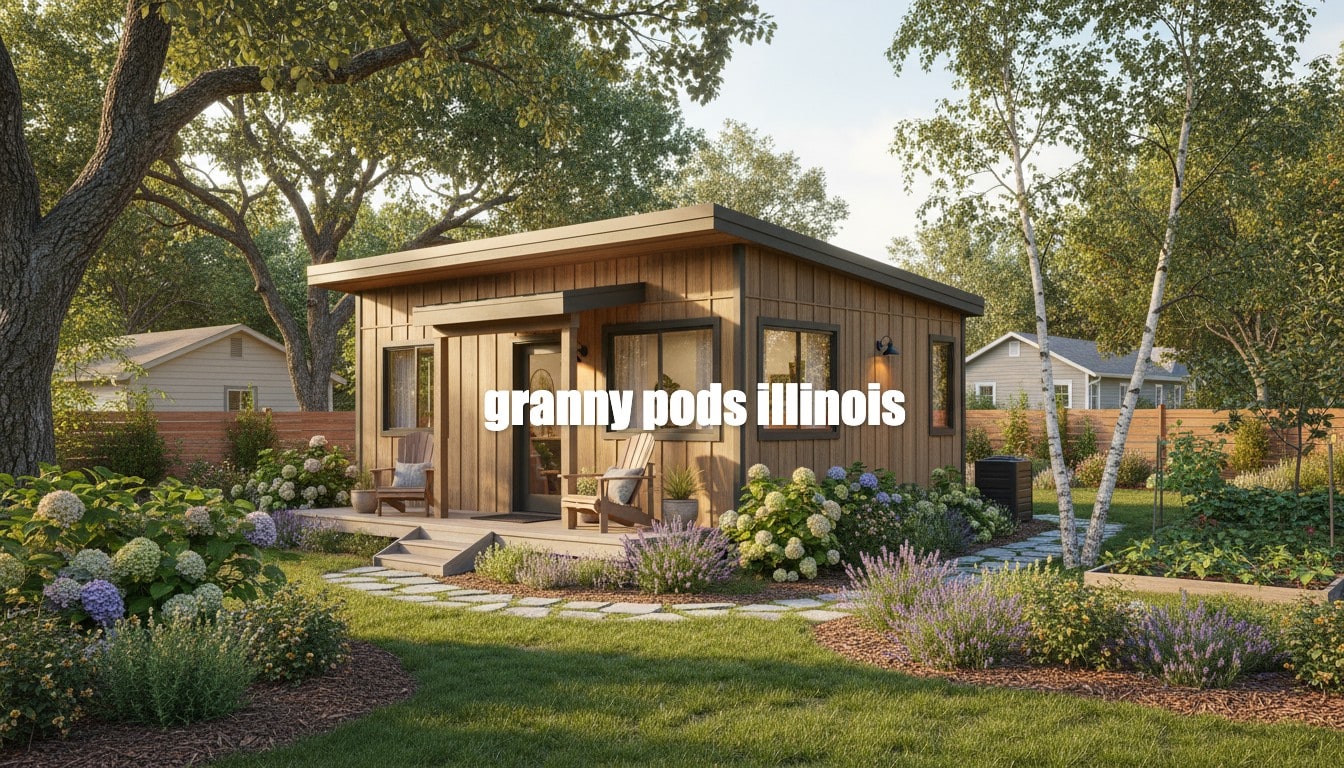
Granny pods are small, detached dwelling units specifically designed to house aging relatives on the same property as their family members. These compact homes, typically ranging from 300 to 800 square feet, provide a perfect balance between proximity and privacy, allowing elderly loved ones to maintain independence while remaining close to family support systems.
In Illinois, we’re seeing significant interest in granny pods as families seek alternatives to expensive nursing homes and assisted living facilities. The concept has gained tremendous traction across the state, from Chicago suburbs to rural communities downstate, as we collectively recognize the value of multigenerational living arrangements. These structures go by several names—accessory dwelling units (ADUs), in-law suites, or mother-in-law cottages—but they all serve the same fundamental purpose: keeping our families together while respecting everyone’s need for personal space.
What makes granny pods particularly appealing to Illinois families is their flexibility. We can install them temporarily or permanently, customize them to meet specific medical needs, and often relocate them if circumstances change. As our state’s population ages—with projections showing that by 2030, one in five Illinois residents will be over 65—granny pods represent a forward-thinking solution to the elder care challenges we’re facing as a community.
Inside the Modern Granny Pod: Features and Design
Modern granny pods are sophisticated living spaces that incorporate everything our aging loved ones need for comfortable, safe, and independent living. Unlike standard tiny houses for sale in Illinois, granny pods are specifically engineered with senior-friendly features that address mobility challenges, health monitoring needs, and accessibility requirements.
We typically design these units to include a bedroom, bathroom, kitchenette, and living area within 300 to 800 square feet. The bathroom features zero-threshold showers with built-in seating, grab bars strategically placed throughout, and non-slip flooring. Doorways are widened to 36 inches to accommodate wheelchairs and walkers, while hallways maintain a minimum width of 42 inches for easy navigation.
There are three primary types of granny pods we see in Illinois:
- Prefabricated Granny Pods: Factory-built units that arrive largely complete and ready for installation, offering faster setup times with standardized accessibility features already incorporated.
- Custom-Built Granny Pods: Structures built on-site or customized to specific needs, allowing us to tailor every aspect to our loved one’s unique requirements and our property’s characteristics.
- Converted Structures: Existing buildings like detached garages or sheds that we renovate and retrofit with senior-friendly features and accessibility modifications.
What truly distinguishes granny pods from standard tiny homes is their integration of medical monitoring capabilities and health-focused design elements. Many modern units include smart home technology that monitors vital signs, detects falls, tracks medication schedules, and alerts family members to potential emergencies. We can install emergency call systems, automated lighting that responds to movement, and climate control systems that maintain consistent, comfortable temperatures—crucial for seniors with health conditions.
Benefits of Granny Pods for Illinois Families
The advantages of granny pods extend far beyond simple convenience—they represent a fundamental shift in how we approach elder care in Illinois. For our families, these structures offer a combination of practical, financial, and emotional benefits that traditional care options simply cannot match.
Proximity and Family Support: With a granny pod on our property, we can provide immediate assistance when needed while respecting our loved one’s independence. We’re just steps away for medication reminders, meal preparation, or emergency response, yet our elderly relatives maintain their own private living space. This arrangement is particularly valuable during Illinois’s harsh winters when traveling to check on relatives in separate homes can be dangerous or impossible.
Independence and Dignity: Our aging family members maintain control over their daily routines, personal space, and lifestyle choices. They can wake when they choose, entertain visitors privately, and live according to their own preferences—freedoms often lost in institutional settings. This autonomy contributes significantly to mental health and overall well-being.
Significant Cost Savings: The financial benefits are substantial. In Illinois, the average cost of a nursing home exceeds $7,000 per month, while assisted living facilities average $4,500 to $6,000 monthly. Over five years, we’re looking at $420,000 for nursing home care. In contrast, a quality granny pod might cost $50,000 to $150,000 as a one-time investment—a fraction of institutional care costs.
Property Value Considerations: A well-designed granny pod can increase our property value by adding functional square footage and versatile living space. Even if we eventually no longer need it for elder care, we can repurpose it as a home office, rental unit (where local regulations permit), or guest house. For those exploring the best tiny home communities in Illinois, understanding how ADUs affect property values is essential.
Emotional and Social Benefits: The psychological advantages of keeping our family close cannot be overstated. Grandchildren can visit grandparents daily, sharing meals and creating memories. Our elderly relatives remain integrated in family life rather than isolated in facilities. Studies consistently show that seniors who maintain strong family connections experience better health outcomes, lower rates of depression, and improved cognitive function.
Legal Considerations for Granny Pods in Illinois
Navigating the legal landscape for granny pods in Illinois requires careful attention to multiple layers of regulation. We must understand that Illinois operates under a home rule system, meaning that while state building codes provide a foundation, individual municipalities and counties have significant authority to establish their own zoning ordinances and restrictions.
State-Level Regulations: Illinois does not have a specific statewide law governing granny pods or ADUs. Instead, we work within the framework of the Illinois Compiled Statutes and the Illinois Accessibility Code, which establishes minimum standards for construction and accessibility. All structures must comply with the International Building Code (IBC) as adopted by Illinois.
Zoning Laws and Local Variations: The most significant legal hurdle we face is local zoning. Each municipality in Illinois has its own zoning ordinance that dictates what types of structures are permitted on residential properties. In general, we need to consider:
- Lot Size Requirements: Many jurisdictions require minimum lot sizes before allowing accessory structures, commonly ranging from 5,000 to 10,000 square feet.
- Setback Requirements: Granny pods must typically be set back a certain distance from property lines, often 5 to 10 feet from side and rear boundaries.
- Maximum Size Restrictions: Local ordinances often limit ADU size to a percentage of the main dwelling (commonly 50-75%) or set absolute square footage caps.
- Occupancy Restrictions: Some areas require that either the main house or the ADU be owner-occupied, and many restrict occupancy to family members only.
Building Codes and Permits: Regardless of local zoning, we must obtain proper building permits before construction or installation. The permit process typically requires detailed construction plans, site plans, proof of proper utility connections, inspections at various stages, and final occupancy permits before anyone can legally reside in the structure.
For those wondering about what counties in Illinois allow tiny houses, similar research applies to granny pods, though the regulations may differ slightly.
Which Illinois Counties Allow Granny Pods?
Understanding which Illinois counties are most accommodating to granny pods helps us make informed decisions about where and how to proceed with our projects. We’ve compiled information on the state’s most populated counties and their general stance on accessory dwelling units.
| County Name | Granny Pod Status | Minimum Lot Size | Maximum Size Allowed | Special Notes |
|---|---|---|---|---|
| Cook County | Case-by-Case | 5,000-7,500 sq ft typical | 50% of main dwelling | Chicago has specific ADU ordinances; suburban communities vary widely. |
| DuPage County | Case-by-Case | 6,000-10,000 sq ft | 600-800 sq ft common | Many municipalities allow with special use permits. |
| Will County | Allowed/Case-by-Case | 5,000-7,500 sq ft | Up to 800 sq ft | Unincorporated areas often more flexible. |
| Kane County | Case-by-Case | 6,000-8,000 sq ft | 600-750 sq ft common | Aurora and larger cities have established processes. |
| Winnebago County | Allowed | 5,000 sq ft minimum | Up to 800 sq ft | Rockford area generally accommodating with proper permits. |
We strongly recommend consulting with local planning departments and working with experienced tiny house builders in Illinois who understand the nuances of local regulations before proceeding with any granny pod project.
Cost of Building a Granny Pod in Illinois
Understanding the full financial picture of granny pod installation helps us make informed decisions and plan appropriately. The costs vary significantly based on size, quality, customization level, and location within Illinois.
Base Unit Costs:
- Prefabricated Granny Pods: $40,000-$90,000 for basic models (300-500 sq ft); $90,000-$150,000 for premium models (500-800 sq ft)
- Custom-Built Granny Pods: $80,000-$120,000 for standard construction (400-600 sq ft); $120,000-$200,000+ for fully customized units
- Converted Structures: $30,000-$80,000 depending on existing structure condition
Site Preparation and Foundation: Illinois’s climate requires proper foundation work to handle freeze-thaw cycles:
- Concrete slab foundation: $4,000-$8,000
- Site grading and drainage: $1,500-$4,000
- Excavation and soil preparation: $2,000-$5,000
Utility Connections:
- Electrical connection and panel: $2,500-$5,000
- Plumbing connection to main sewer: $3,000-$7,000
- HVAC installation: $3,000-$8,000
- Water line extension: $1,500-$3,500
Permits and Professional Fees:
- Building permits: $1,000-$3,000
- Architectural/engineering plans: $2,000-$5,000
- Inspection fees: $500-$1,500
Illinois Climate-Specific Costs:
- Enhanced insulation (R-30 walls, R-49 ceiling): $2,500-$5,000
- Energy-efficient windows and doors: $3,000-$6,000
- Heating system for extreme cold: $2,000-$4,000
Total Investment Range: For a complete, move-in ready granny pod in Illinois, we’re typically looking at total costs of:
- Basic prefab installation: $55,000-$110,000
- Mid-range custom build: $110,000-$175,000
- Premium custom build: $175,000-$250,000+
Cost Comparison to Institutional Care:
- Nursing Home Care: Average $7,300/month ($87,600/year). Over 5 years: $438,000
- Assisted Living: Average $4,800/month ($57,600/year). Over 5 years: $288,000
- Granny Pod: $110,000 initial investment + $15,000 over 5 years = $125,000 total
The savings become even more dramatic over longer periods, while providing superior quality of life.
The Granny Pod Installation Process in Illinois
Successfully installing a granny pod in Illinois requires careful planning and execution through multiple stages. We’ve outlined a comprehensive step-by-step process to help navigate this journey from initial concept to final occupancy.
Step 1: Research Local Zoning Laws (Timeline: 1-2 weeks)
Our first critical step is understanding what’s legally permissible in our specific location. We need to contact our local planning department, review our property’s zoning classification, verify lot size requirements and setback distances, and identify any occupancy restrictions or owner-occupancy requirements.
Step 2: Obtain Necessary Permits (Timeline: 4-8 weeks)
Once we’ve confirmed our project is feasible, we begin the permitting process by hiring a licensed architect to create detailed construction plans, preparing a site plan, and submitting building permit applications to our local building department.
Step 3: Site Preparation (Timeline: 1-3 weeks)
Illinois’s climate and terrain present specific site preparation challenges. We need to assess soil composition and drainage, ensure proper grading to prevent water accumulation, and consider Illinois’s frost line (36-42 inches deep) for foundation stability.
Step 4: Foundation Installation (Timeline: 1-2 weeks)
The foundation must withstand Illinois’s freeze-thaw cycles and provide stable, level support. We excavate, install gravel base, lay vapor barriers, install reinforcement, and pour concrete, ensuring proper insulation beneath and around the foundation.
Step 5: Utility Connections (Timeline: 2-4 weeks)
Illinois winters make reliable utilities essential for safety and comfort. Licensed electricians run service from the main panel, plumbing connects to existing sewer lines with water lines buried below frost line, and HVAC systems are installed rated for Illinois’s temperature extremes.
Step 6: Structure Delivery and Installation (Timeline: 1-3 days for prefab; 8-16 weeks for custom build)
For prefabricated units, we coordinate delivery timing, ensure clear access routes, and arrange for crane service if needed. For custom-built units, we frame the structure, install roofing with appropriate snow load ratings, and complete all interior finishes.
Step 7: Final Inspections (Timeline: 1-2 weeks)
Before anyone can occupy the granny pod, we must pass all required inspections including foundation, electrical, plumbing, HVAC, and final building inspection to receive the occupancy permit.
Total Timeline: From initial research to move-in, we should expect:
- Prefabricated granny pod: 3-5 months
- Custom-built granny pod: 6-9 months
- Complex projects requiring variances: 8-12 months
Design Considerations for Illinois Granny Pods
Designing a granny pod for Illinois requires balancing our state’s demanding climate conditions with the specific accessibility and comfort needs of aging residents.
Weatherproofing for Illinois’s Four Seasons: We should install high-performance insulation with minimum R-values of R-30 for walls and R-49 for ceilings. Triple-pane, low-E windows with argon gas fill provide superior insulation against both winter cold and summer heat. We choose durable roofing materials rated for Illinois snow loads (20-30 psf) and install ice and water shields to prevent ice dam damage.
Energy Efficiency Considerations: We install high-efficiency heat pumps or furnaces (95+ AFUE rating) with programmable thermostats. Mini-split systems work exceptionally well in granny pods, providing both heating and cooling with excellent efficiency. We meticulously seal all penetrations and joints to minimize energy waste.
Accessibility Features for Aging Residents: We eliminate all thresholds and steps, creating seamless transitions from outdoors to indoors. All doorways are minimum 36 inches wide, with hallways at least 42 inches wide. We install roll-in showers with zero threshold, built-in seating, handheld shower heads, and grab bars strategically placed for support.
Smart Home Technology Options: We can integrate systems that track vital signs, detect falls, and alert family members to potential health crises. Voice-activated controls allow our loved ones to adjust lighting, temperature, and entertainment without physical interaction. Motion-sensor lights illuminate pathways automatically, preventing falls during nighttime bathroom trips.
At Great Lakes Tiny Homes, we genuinely love meeting the people we build for and understanding their unique stories and needs. We believe that creating the perfect granny pod starts with personal connection—getting to know our clients, their loved ones, and their specific vision for this important living space. We always welcome potential customers to schedule site visits where they can tour our shop, view available models, and meet our team face-to-face.
Making the Right Decision for Your Illinois Granny Pod
As we’ve explored throughout this comprehensive guide, granny pods represent a meaningful solution to one of the most challenging decisions Illinois families face: how to care for our aging loved ones while honoring their independence and maintaining family connections.
The benefits are substantial—proximity and privacy, independence and dignity, significant cost savings compared to institutional care, and the immeasurable emotional value of keeping our family close. We’ve learned that successful granny pod projects require careful planning, realistic budgeting, and expert guidance.
Local expertise makes a meaningful difference in this process. Professionals like those at Great Lakes Tiny Homes, who understand Illinois’s specific building codes, climate challenges, and regulatory environment, can guide us through the complexities while ensuring our granny pod meets the highest standards of quality, safety, and comfort.
Next Steps in Your Granny Pod Journey
If we’re seriously considering a granny pod for our Illinois property, taking systematic, well-planned steps will set us up for success:
1. Research Local Zoning Laws (Week 1-2): Contact our municipal or county planning department to request information about accessory dwelling unit regulations in our specific area. For those exploring broader options, researching tiny houses for sale in Chicago, Illinois or other cities can provide additional context.
2. Consult with Family Members (Week 2-3): Have honest, open conversations with our aging loved one about their needs, preferences, and concerns regarding a granny pod.
3. Set a Realistic Budget (Week 3-4): Calculate total project costs including the unit itself, site preparation, utility connections, permits, and contingency funds.
4. Explore Financing Options (Week 4-6): Research home equity loans, personal loans, construction loans, or FHA Title 1 loans.
5. Contact Reputable Builders (Week 6-8): Research builders with specific experience in granny pods, ADUs, or accessible housing in Illinois. Consider exploring tiny house builders in Chicago, Illinois and other areas who may have relevant expertise.
Finding Expert Guidance for Your Project
The success of our granny pod project depends significantly on the expertise and experience of the professionals we choose to work with. Great Lakes Tiny Homes offers the specialized expertise and personal approach that this important project deserves. With deep understanding of local building codes and regulations across Illinois, we’ve helped numerous families create comfortable, accessible living spaces that meet both regulatory requirements and the unique needs of aging loved ones.
We view our relationship with clients as a partnership rather than a simple transaction. We’re here to guide families through every step of the process, from initial concept discussions through final occupancy. If we’re considering a granny pod for our Illinois property, we encourage reaching out to Great Lakes Tiny Homes for a consultation.
Conclusion: Creating a Supportive Home for Your Loved Ones
Granny pods represent more than a housing solution—they embody our commitment to family, our recognition that our elderly relatives deserve to age with grace and autonomy, and our belief that the best care happens when families remain connected.
The investment we make in a granny pod—whether measured in dollars, time, or effort—pales in comparison to the returns we receive in family connection, peace of mind, and the knowledge that we’ve provided our loved ones with the care and respect they deserve. Let’s take that first step together. Our loved ones have been there for us throughout our lives—now it’s our turn to be there for them, creating homes where independence and family support coexist, where dignity is preserved, and where the bonds that matter most are strengthened.
Frequently Asked Questions About Granny Pods in Illinois
Are granny pods legal in all parts of Illinois?
Granny pods are not universally legal throughout Illinois. Our state operates under a home rule system where individual municipalities and counties establish their own zoning ordinances governing accessory dwelling units. We must research the specific regulations in our municipality and county before proceeding with any granny pod project.
How much does a typical granny pod cost in Illinois?
The total cost of a granny pod in Illinois typically ranges from $55,000 to $250,000, depending on size, quality, and customization level. Most Illinois families invest $110,000-$175,000 for a complete, move-in ready granny pod. While this represents a significant investment, it’s substantially less expensive than nursing home care, which averages $87,600 annually in Illinois.
Can I install a granny pod on any size property in Illinois?
No, we cannot install a granny pod on any size property in Illinois. Most municipalities that allow accessory dwelling units require minimum lot sizes, typically ranging from 5,000 to 10,000 square feet. We should verify our specific property’s zoning classification and dimensional requirements with our local planning department before assuming a granny pod is feasible.
Do I need special insurance for a granny pod?
Yes, we typically need to adjust our homeowners insurance to properly cover a granny pod. Most standard homeowners policies won’t automatically cover a separate dwelling structure used as a residence, so we must contact our insurance provider to add appropriate coverage. Insurance costs typically increase by $300-$800 annually when we add a granny pod.
How do utilities work for a granny pod in Illinois?
Granny pods in Illinois typically connect to the main home’s existing utilities. For electricity, we usually run a dedicated circuit or install a sub-panel from our main electrical panel. For plumbing, we connect to our existing water supply and sewer system, ensuring all pipes are buried below Illinois’s frost line (36-42 inches) and properly insulated to prevent freezing.
Can I rent out my granny pod in Illinois?
Whether we can rent out our granny pod in Illinois depends entirely on local zoning ordinances and any conditions attached to our permits. Many municipalities that allow granny pods specifically restrict them to family members only, prohibiting rental to unrelated individuals. We must research our specific local regulations before considering rental use.
How do granny pods handle Illinois winters?
Granny pods can handle Illinois winters very effectively when properly designed and constructed with our state’s climate in mind. We must ensure high-performance insulation (minimum R-30 walls, R-49 ceiling), triple-pane windows, proper air sealing, and heating systems rated for extreme cold. When we incorporate these Illinois-specific design elements, granny pods provide safe, comfortable year-round housing.