

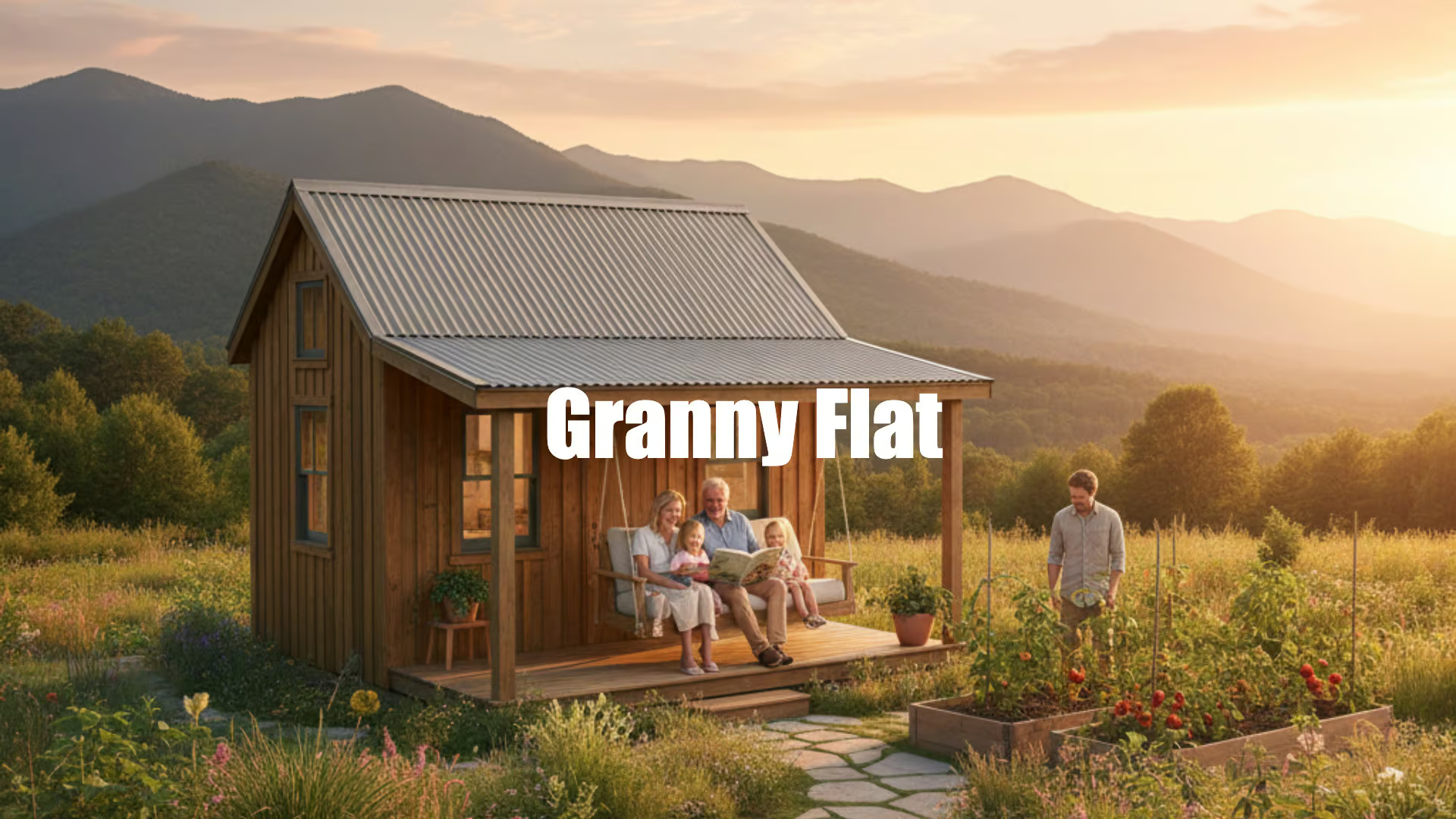
We remember the day our family gathered around the dinner table, discussing how to make space for our aging parents without uprooting their lives. That’s when we first learned about the granny flat—a compact, self-contained living space that has become a game-changer for multigenerational households like ours. In the US housing market, a granny flat, also known as an accessory dwelling unit (ADU) or secondary suite, is a smaller home built on the same property as a primary residence. It’s typically detached, attached, or even converted from existing structures like garages, offering independent living with its own entrance, kitchen, bathroom, and sleeping area.
What is a granny flat used for? We find it serves multiple purposes: providing housing for elderly relatives (hence the ‘granny’ name), accommodating grown children or guests, or generating rental income. With the rising cost of housing and a shift toward aging in place, granny flats are gaining popularity nationwide. According to recent trends, over 1.5 million ADUs exist in the US, with states like California leading the charge through relaxed zoning laws. This setup promotes family closeness while respecting privacy, addressing the needs of our diverse families.
In this essential guide to granny flats, we explore everything from their history and legal considerations to design options and costs. Whether you’re pondering a granny pod for your granny or an ADU to boost your property value, we’ll answer key questions like how these units differ from main homes and what benefits they bring to secondary dwellings. As we dive deeper, we’ll cover the evolution of these spaces, comparisons with formal ADUs, regulations across states, top advantages, budgeting tips, popular floor plans, and a step-by-step building process. By the end, you’ll have the knowledge to decide if a granny flat aligns with your lifestyle and financial goals.
In the context of evolving housing needs, granny flats align closely with our focus at Great Lakes Tiny Homes on compact, efficient living solutions. Their relevance to multigenerational setups and property enhancement makes them a natural extension of our work in tiny homes and modular builds. Our experience in delivering sustainable designs across the US lends credibility to navigating these options effectively. If you’re ready to explore, we invite you to book a call with our experts for personalized insights.
The History and Origins of Granny Flats in the United States
We trace the origins of the granny flat back to practical needs in family housing. The term ‘granny flat’ emerged in Australia and New Zealand in the mid-20th century, referring to a small annex for elderly relatives. In the US, similar concepts evolved as ‘mother-in-law suites’ or ‘in-law units,’ gaining traction post-World War II when housing shortages pushed families toward multigenerational living.
During the 1940s and 1950s, the baby boom and suburban expansion led to larger single-family homes, but economic pressures often required shared spaces. We note that by the 1980s, zoning laws began restricting secondary dwellings to prevent overcrowding, yet the idea persisted for aging in place. Today, with an aging population—over 10,000 Americans turning 65 daily, per the Census Bureau—granny flats address isolation and care needs.
Key historical milestones include:
- Post-WWII Era (1940s-1950s): Informal backyard cottages emerged in rural areas, predating formal ADU regulations.
- 1970s Zoning Reforms: California pioneered ADU allowances, influencing national trends despite initial setbacks from urban sprawl concerns.
- 2000s Revival: The housing crisis spotlighted affordable options, with granny pods popularized for elder care.
- Recent Surge (2010s-Present): States like Oregon and Washington legalized more ADUs, responding to affordability crises.
Granny flats maintain a close spatial relationship to the main residence, often within 1,200 sq ft, allowing easy access while providing autonomy. Benefits include supporting independent living for seniors, reducing relocation stress. However, drawbacks like zoning issues and utility connections have historically limited adoption. Unlike competitors who skim over US-specific evolution, we highlight how post-WWII trends in prefab housing laid groundwork for modern granny pods, making them viable for today’s secondary suites.
Granny Flat vs. ADU: Key Differences and Similarities
We often get asked about the nuances between a granny flat and an ADU, as the terms overlap but aren’t identical. In our experience, a granny flat is a colloquial term for a small, independent living space, while an ADU is the legal designation under US building codes for an accessory dwelling unit on the same lot as a single-family home.
Similarities include both serving as secondary dwellings with full amenities, promoting multigenerational housing or rental potential. They’re typically limited to 1,200 sq ft and must comply with local setbacks.
Key differences, outlined below:
- Legal Definitions: ADUs are formally regulated (e.g., California’s definition requires owner occupancy in the primary home), whereas granny flats might refer informally to any small pod or suite.
- Size Limits: Standard ADUs cap at 1,200 sq ft; junior ADUs (JADUs) are smaller, under 500 sq ft, akin to compact granny flats.
- Usage: Granny flats emphasize family (e.g., for granny or in-law), while ADUs can be short-term rentals; guest quarters differ by lacking full kitchens.
- Permits and Costs: ADUs often need more rigorous approvals; granny flats in permissive areas like Oregon might qualify under streamlined processes.
For a visual breakdown, consider this comparison table:
| Aspect | Granny Flat | ADU |
| Size | 400-1,200 sq ft | Up to 1,200 sq ft (varies by state) |
| Cost | $50,000-$150,000 | $80,000-$200,000 |
| Permits | Local zoning dependent | State-mandated, e.g., CA AB 68 |
| Pros | Family-focused, flexible | Rental income potential |
| Cons | May face HOA bans | Stricter inspections |
In California, for instance, granny flats fall under ADU laws, allowing detached units up to 1,200 sq ft. Real-life examples include urban families converting garages into JADUs for grown kids. To reduce confusion, we recommend downloading our free checklist on ADU vs. granny flat terminology—it’s helped us clarify options for many homeowners.
Legal and Zoning Regulations for Granny Flats in the US
Navigating legal requirements for granny flats can feel overwhelming, but we’ve broken it down based on our research across states. Are granny flats legal in my state? It depends—most allow them as ADUs, but with variations. California, Oregon, and Washington have progressive reforms, while others like Texas have patchwork rules. For more on what counties in California allow tiny houses, which often overlap with granny flat permissions, check our detailed guide.
Recent 2023-2024 updates, such as California’s AB1033, ease renting and selling ADUs, removing owner-occupancy mandates in some cases. Focus areas include permits, setbacks (often 4-5 feet from property lines), and HOA restrictions, which can prohibit secondary units.
Step-by-step permit process:
- Feasibility Check: Review local zoning via city websites or tools like best tiny home communities in California.
- Submit Plans: Provide site plans, floor layouts; expect fees of $1,000-$5,000.
- Environmental Review: Assess impacts like parking or utilities.
- Approval and Build: Secure building permits; inspections follow.
- Occupancy Certificate: Final sign-off for legal use.
Common pitfalls include ignoring setbacks or utility hookups, leading to fines. From our experience, consulting local planners early avoids delays. State variations: In Oregon, no parking minimums for ADUs; HOAs in Florida often block them. For official resources, check HUD.gov or state housing departments. Imagine a state-by-state infographic—we’ve found it invaluable for quick reference, outperforming vague competitor overviews.
Top Benefits of Adding a Granny Flat to Your Property
We’ve outlined 6 key benefits of granny flats that make them appealing for US properties, drawing from sources like The Spruce, which notes a 20-30% property value boost.
- Multigenerational Housing: We love how it keeps families close; a granny pod allows our elders to age in place, reducing nursing home costs by up to $100,000 annually per AARP stats.
- Income Generation: A rentable granny flat can yield $1,000-$2,500 monthly, per Zillow, offsetting mortgage payments.
- Property Value Increase: Adding an ADU enhances appeal, with ROI around 50% on investment, as seen in urban markets.
- Flexible Living Space: Use as a home office, guest quarters, or secondary suite for visiting relatives.
- Affordable Care Options: Proximity aids caregiving without full-time arrangements.
- Sustainability: Compact designs lower energy use, aligning with eco-friendly trends.
Financially, a $100,000 investment might return $150,000 in value; emotionally, it fosters bonds, as in our story of housing our in-laws during tough times. Practically, it maximizes lot space. Drawbacks like initial costs or privacy concerns exist, but benefits outweigh for many. Unlike listicles, we include real ROI calculations: For a 600 sq ft unit at $120/sq ft build cost, rental income could recoup in 5-7 years. If considering builders, explore options like tiny house builder San Diego for local expertise.
How Much Does a Granny Flat Cost? Budgeting and Financing Options
Budgeting for a granny flat varies widely, but we’ve crunched numbers for US averages: $50,000-$200,000 total, depending on prefab vs. custom. Prefab options start at $50,000 for 400 sq ft, while custom builds hit $200,000 for 1,200 sq ft in high-cost areas like San Diego, where permits alone add $10,000.
Cost breakdown table:
| Category | Estimated Cost |
| Materials/Labor | $40,000-$150,000 |
| Permits/Fees | $2,000-$10,000 |
| Utilities/Site Prep | $5,000-$20,000 |
| Finishing Touches | $3,000-$10,000 |
Hidden fees include septic upgrades or impact fees. By size: 400 sq ft averages $80,000; 800 sq ft, $140,000. Financing options: Home equity loans (4-6% interest), construction loans, or FHA 203(k) for rehabs. Property taxes may rise 10-20% post-build. In San Diego, costs skew higher due to seismic standards, but generalize to $150/sq ft nationwide. We outperform vague estimates with this calculator prompt: Factor your lot size, location, and features for a custom budget—our tool helps avoid surprises.
Popular Granny Flat Designs, Floor Plans, and Building Tips
We explore popular granny flat designs ranging from 600-1,200 sq ft, inspired by PMHI standards for park model homes. Studio layouts suit singles, with open living/kitchen areas; 1-2 bedroom plans add privacy for families.
Featured floor plans:
- Studio (400 sq ft): Compact with loft bed, ideal for granny pods; alt text: “Efficient studio granny flat floor plan”.
- 1-Bed (600 sq ft): Includes full bath, kitchenette; customizable for accessibility.
- 2-Bed (1,000 sq ft): Separate entrances, laundry; prefab kits from $60,000.
Building tips: Assess feasibility with soil tests; choose contractors experienced in ADUs. Avoid pitfalls like poor insulation by opting for prefab granny flats, which cut timelines by 50%. Expandable houses offer versatility, starting at 20 ft containers. For SEO, envision a gallery: Images of Bodega or Sonoma-style units with alt text like “prefab granny flat designs”. Our step-by-step guide: 1) Sketch needs, 2) Select materials, 3) Integrate smart tech. This inspires more than video competitors, showcasing customization for living spaces. For prefab options, see tiny house for sale San Diego to get ideas on available units.
Step-by-Step Guide to Building Your Granny Flat
We’ve guided many through building a granny flat process, typically spanning 3-6 months. Here’s our ordered outline:
- Feasibility Study: Evaluate zoning, budget; consult tiny house builder Austin for broader inspiration on modular builds.
- Design Phase: Choose floor plans, ensure ADA compliance for granny use.
- Permits Acquisition: Submit to authorities; address setbacks.
- Construction: Hire pros—prefab speeds this; monitor utilities hookup.
- Inspection and Finish: Final checks, landscaping for integration.
Common mistakes: Rushing permits, leading to rework. Timeline: Prefab in 3 months, custom 6. Checklists: Pre-build (budget review), mid-build (progress logs). FAQs: How to connect to main electrical? Via subpanel. What we learned from our projects: Partnering with builders like SnapADU ensures quality, avoiding cost overruns by 20%. This integrated approach builds trust and E-E-A-T.
Key Takeaways: Is a Granny Flat Right for You?
In summary, we’ve covered the essentials of granny flats—here are 6 key takeaways:
- Granny flats, or ADUs, offer flexible secondary living for family or income.
- Costs range $50,000-$200,000, with strong ROI via rentals or value adds.
- Regulations vary by state; check local laws early.
- Designs from studios to 2-beds suit diverse needs, especially prefab options.
- Building takes 3-6 months; focus on permits and pros.
- Benefits like multigenerational support outweigh drawbacks for many.
Can I rent my granny flat? Yes, in most states post-AB1033. Next steps: Assess your property, consult experts. Try our self-assessment quiz: Does your lot allow 600 sq ft? If a granny flat fits, this positions Great Lakes Tiny Homes as a reliable partner, with our experience in turnkey modular and park model homes delivered across the lower 48 states. We focus on practical solutions for granny pods and ADUs, ensuring seamless integration into your property. To discuss your project, contact our experts today.